
Mobile Billboard Advertising for Retail: 7 Ideas That Drive Foot Traffic
Last Updated: October 23, 2026
Quick Summary
Mobile billboard advertising for retail turns your brand message into a moving asset, traveling through high-traffic areas, shopping districts, and neighborhoods to reach customers during daily routines. This approach breaks through the noise of static ads and digital banners by combining visibility with movement, whether through LED trucks showcasing video, glass-walled showrooms, or vinyl-wrapped vehicles.
- LED digital trucks running concentrated routes 2-3 weeks before store opening drive day-one traffic and opening-week foot traffic compared to traditional launch tactics alone.
- Mobile billboards work best for short-window promotions like 48-hour flash sales when scheduled Friday through Sunday in high-traffic retail corridors to create urgency and FOMO.
- Video content on LED trucks captures attention for 5-8 seconds as the truck passes, so keep videos to 15-30 seconds focused on one product or benefit.
- Measure campaign ROI using foot traffic counting, unique coupon codes, custom phone numbers, or custom landing pages rather than relying on impressions alone.
- Mobile billboard advertising for retail works best for local retail chains, store openings, regional product launches, and businesses competing on local market share within 5-10 mile radius.
Table of Contents
- What Mobile Billboard Advertising for Retail Actually Does
- 7 Mobile Billboard Advertising Ideas That Work for Retail
- 1. Store Opening Blitz with LED Digital Trucks
- 2. Weekend Flash Sales and Limited-Time Promotions
- 3. Seasonal Product Launches with Video Ads
- 4. Geo-Targeted Routes Around Competitor Locations
- 5. Event Day Traffic Drives for Festivals and Sports
- 6. Brand Awareness Campaigns in New Markets
- 7. Glass-Walled Mobile Showrooms for Product Demos
- Store Opening Advertising Ideas Using Mobile Billboards
- Retail Advertising Ideas Beyond the Truck
- Mobile Advertising Campaign Best Practices
- Measuring Results: How to Track ROI and Store Visits
- Mobile Billboards vs. Traditional Advertising for Retail
- Conclusion
- Frequently Asked Questions
What Mobile Billboard Advertising for Retail Actually Does
Mobile billboard advertising for retail turns your brand message into a moving asset, traveling through high-traffic areas, shopping districts, and neighborhoods to reach customers during daily routines.
Mobile billboard advertising for retail can break through the noise.
The core advantage is visibility plus movement.
What separates effective mobile billboard advertising for retail from wasted spend is strategy.
This guide covers seven mobile billboard advertising ideas that work for retail, plus a framework for measuring real ROI.
7 Mobile Billboard Advertising Ideas That Work for Retail
1. Store Opening Blitz with LED Digital Trucks
A new retail location needs immediate awareness. Learn how digital advertising trucks were used successfully for a business promotion campaign.
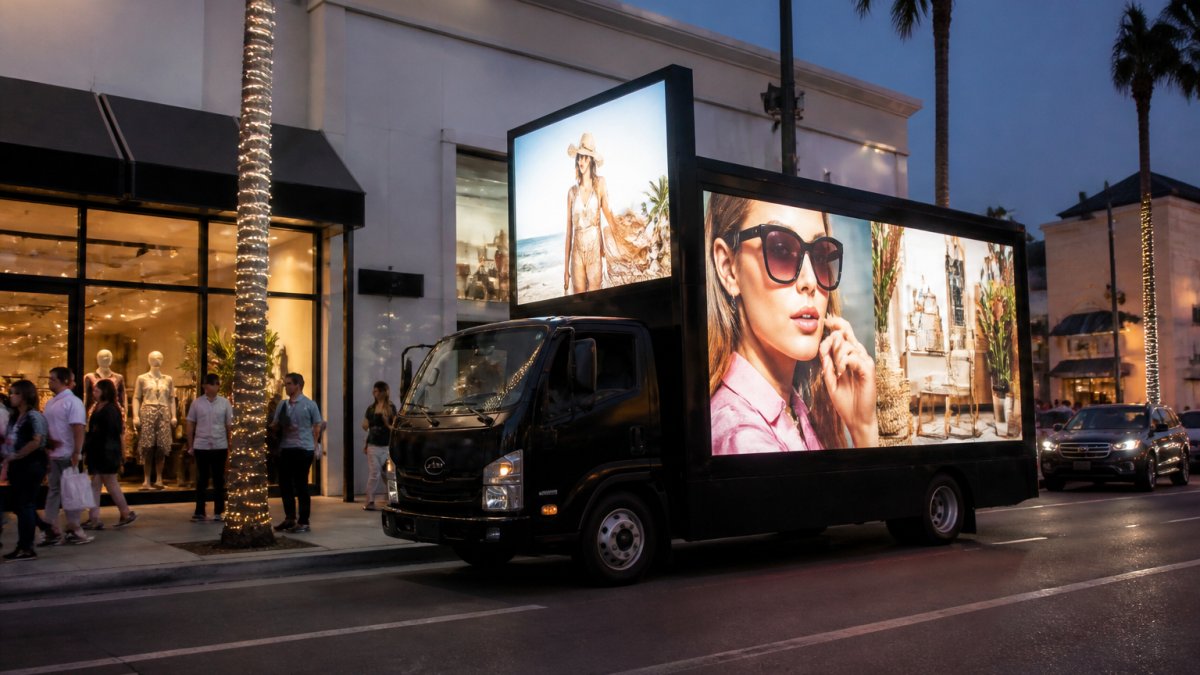
The truck displays your opening date, location, and a compelling reason to visit, a grand opening discount, exclusive product, or limited-time offer.
Mobile billboard advertising for retail can contribute to stronger opening-week foot traffic compared to traditional launch tactics alone, the vehicle can become a conversation starter.
Why this works: Repetition builds recall.
2. Weekend Flash Sales and Limited-Time Promotions
Mobile billboard advertising for retail shines during short-window promotions. A 48-hour or weekend flash sale needs rapid awareness, and a digital truck delivers it.
Schedule the truck Friday through Sunday evening in high-traffic retail corridors and shopping centers.
It works well for clearance events, seasonal sales, or category-specific promotions like “50% Off Summer Inventory,” reaching people who might miss your email, social media, or in-store signage.
Common mistake: Running the truck the entire week dilutes urgency.
3. Seasonal Product Launches with Video Ads
When introducing a new product line, mobile billboard advertising for retail lets you showcase it in motion.
A clothing retailer might show a quick fashion video, a sporting goods store could display product demos, and a home goods retailer could show before-and-after room transformations.
Route the truck through neighborhoods and shopping areas where your target demographic shops, timed to in-store availability.
Pro Tip: Video content on LED trucks captures attention for 5-8 seconds as the truck passes. Keep your video message simple, high-contrast, and focused on ONE product or benefit. Complex messaging gets lost.
4. Geo-Targeted Routes Around Competitor Locations
This is where mobile billboard advertising for retail becomes competitive intelligence in motion. Route your truck through high-traffic areas around competitor stores, emphasizing what makes your location different.
This tactic works best with a genuine competitive advantage: lower prices, better selection, superior service, or exclusive products.
Route planning matters here: Work with your mobile billboard provider to identify the exact streets and timing that put your truck in front of competitor traffic.
5. Event Day Traffic Drives for Festivals and Sports
Local festivals, concerts, and sporting events draw crowds. Mobile billboard advertising for retail can position your store as the convenient stop before or after the event.
The truck’s mobility lets you follow event traffic flow. Park near event parking areas, run routes on approach streets, and time your campaign to event schedules.
Best for: Retailers within 1-3 miles of recurring events (weekly sports games, monthly farmers markets, seasonal festivals). The closer your store to the event, the more effective this strategy.
6. Brand Awareness Campaigns in New Markets
Entering a new geographic market requires name recognition. Mobile billboard advertising for retail builds awareness faster than traditional methods alone.
A retail chain expanding into a new city could run a 4-6 week campaign covering major neighborhoods, shopping districts, and high-traffic corridors. The message is simple, store name, location, opening date, so people already know you when the store opens.
This approach can be highly effective. While digital billboards, TV, and radio can sometimes be skipped, a mobile billboard rolling down the street can command attention.
Scale consideration: If you’re opening multiple locations in a new market, you might run multiple trucks on different routes simultaneously to accelerate awareness.
7. Glass-Walled Mobile Showrooms for Product Demos
A furniture retailer could showcase room setups, an appliance store could display product features, and a technology retailer could show devices in use.
This format can deliver strong engagement. Browse available glass-walled display vehicle options to book for your retail campaign.
Ideal for: Premium products, new categories entering a market, or high-consideration purchases where seeing the product in context drives buying decisions.
Store Opening Advertising Ideas Using Mobile Billboards
Store openings are one of the highest-ROI applications for mobile billboard advertising for retail.
Pre-opening phase (3-4 weeks before launch): Run the truck at moderate frequency through residential neighborhoods to build curiosity. Message: “Grand Opening Coming [Date]” with location details.
Awareness phase (2 weeks before): Increase frequency. Add specific reasons to visit: opening discount, exclusive product, or limited-time offer. Message focus: “New [Store Name] Opening, Save 20% Opening Week.”
Urgency phase (1 week before): Run daily or near-daily routes. Add countdown messaging.
Launch week: Concentrate routes around the store location. Message focus: “We’re Open Today, [Address], Grand Opening Specials Inside.”
The mobile billboard advertising for retail approach can be effective because it creates multiple touchpoints.
Retail Advertising Ideas Beyond the Truck
While mobile LED trucks are the flagship format, other mobile billboard advertising for retail options exist:
Vinyl-wrapped vehicles: Lower cost than LED trucks; best for longer-term campaigns (4+ weeks) with a stable message, and excellent for brand awareness and store location promotion.
Contact Us Now for a Free Consultation →
Static mobile billboards: Parked vehicles with large vinyl panels, lower cost and fixed location, useful for sustained campaigns in high-traffic areas.
Wrapped transit vehicles: Buses, taxis, or rideshare vehicles with your ad, broader reach and less placement control.
Sampling trucks: Vehicles that distribute product samples while displaying your brand, best for launches or awareness, combining advertising with direct engagement.
LED trucks offer the highest impact and flexibility, vinyl wraps offer cost efficiency, and sampling trucks offer engagement.
Mobile Advertising Campaign Best Practices
1. Define Your Objective First
Are you driving store traffic? Building brand awareness? Promoting a specific sale?
2. Route Planning Is Everything
The best creative on the wrong route wastes money.
3. Keep Messaging Simple
You have 5-8 seconds as the truck passes. One headline, one image or video, one call-to-action. Cluttered messaging gets ignored.
4. Use Video on LED Trucks
Digital LED trucks can display static images or video.
5. Coordinate with Other Channels
Mobile billboard advertising for retail works best alongside email, social media, and in-store promotions.
6. Run Concentrated Campaigns
A two-week intensive campaign beats a four-week sparse one. Frequency and repetition build recall.
7. Test and Adjust
If a route isn’t generating traffic, change it. If messaging isn’t resonating, update it.
Measuring Results: How to Track ROI and Store Visits
This is where many retailers struggle.
Direct Measurement Methods:
Foot traffic counting: Place a counter at store entrances during the campaign.
Coupon codes: Create a unique coupon code displayed only on the mobile billboard truck.
Phone tracking: Use a unique phone number on the truck.
Custom landing page: Display a unique URL on the truck (e.g., “Visit [StoreName].com/truck”).
Indirect Measurement Methods:
Customer surveys: Ask new customers how they heard about your store.
Pro Tip: The most reliable measurement combines multiple methods. Discover the specific analytics tool and method to measure mobile billboard campaign performance using industry-standard tracking platforms.
Avoid the trap of measuring impressions alone. A mobile billboard truck might generate 10,000 impressions per day, but impressions don’t equal sales. Focus on foot traffic, conversions, and actual customer behavior. Impressions are a vanity metric unless they translate to store visits.
Mobile Billboards vs. Traditional Advertising for Retail
How does mobile billboard advertising for retail stack up against radio, television, and static billboards?
| Channel | Cost per Month | Reach | Targeting | Flexibility | Engagement |
|---|---|---|---|---|---|
| Mobile Billboard (LED) | Varies by market | 10K-50K daily impressions | Geographic routes, time-based | High, change message weekly | High, movement captures attention |
| Static Billboard | Varies by location | 5K-20K daily impressions | Fixed location only | Low, message locked for contract | Low, easy to ignore |
| Radio Spot | $500-2K | 20K-100K weekly | Demographic targeting | Medium, can rotate messaging | Medium, audio only, easy to skip |
| TV Spot | $2K-10K | 50K-500K weekly | Demographic + time-based | Low, locked into time slots | High, video and audio, hard to ignore |
| Digital Display (Online) | $500-2K | Highly variable | Precise demographic + behavioral | High, real-time optimization | Low, ad blindness, easy to skip |
Mobile billboard advertising for retail advantages:
- Impossible to skip or ignore (it’s a physical vehicle)
- Highly targetable by geography and time
- Can be adjusted mid-campaign
Mobile billboard advertising for retail limitations:
- Weather-dependent (trucks don’t run in heavy rain or snow)
- Requires good route planning (wrong route wastes money)
- Slower to launch (requires vehicle coordination)
Best for: Local retail chains, store openings, regional product launches, seasonal promotions, and retail businesses competing on local market share.
Not ideal for: National brands needing mass reach, highly targeted demographic audiences (mobile billboards reach broad geographic areas), or campaigns requiring precise measurement of individual customer attribution.
Mobile billboard advertising for retail can be highly effective when you’re competing on geography and local awareness. If your customers are within a 5-10 mile radius and you need them to visit a physical location, mobile billboards can be a powerful alternative to traditional media.
Conclusion
Mobile billboard advertising for retail delivers results because it reaches customers where they live, work, and shop, and makes it impossible for them to ignore your message.
Mobile advertising best practices guide and retail foot traffic measurement strategies provide additional frameworks for campaign planning and measurement.
Contact us now for a free consultation to discuss your retail advertising goals and how mobile billboard advertising for retail can drive foot traffic to your locations.
Frequently Asked Questions
How can mobile billboard advertising help a retail store attract more customers?
Mobile billboards place your message directly in front of foot traffic in high-density areas where your customers shop and work. Unlike stationary billboards, moving trucks reach multiple neighborhoods in a single day, creating repeated brand impressions. LED trucks display dynamic video and image ads that capture attention far more effectively than static signage. Retailers report that mobile campaigns drive immediate store visits, especially when timed around promotions, new store openings, or seasonal sales. The combination of motion, size, and location targeting makes mobile advertising one of the most direct ways to convert awareness into actual foot traffic.
What should a retail mobile billboard ad say?
Keep your message short and direct: a single clear offer, your store location, and a reason to act now. Examples: ‘Grand Opening This Saturday, 25% Off’ or ‘New Location on Main Street, Open Today.’ Use large, high-contrast text readable from 100+ feet away. Include your store name, address, and hours. Avoid cluttering the design with too many colors or competing messages. If using an LED truck, rotate 2-3 variations of your core message every 10 seconds to maintain attention. For product-focused ads, show the item, price, and location. The goal is instant comprehension, drivers and pedestrians have only 3-5 seconds to read your ad.
How do retailers measure the results of a mobile billboard campaign?
Track foot traffic using in-store traffic counters, point-of-sale data, and customer surveys. Ask customers how they heard about you during the campaign period. Use unique phone numbers or QR codes on the mobile billboard to measure direct responses. Compare store visits during the mobile campaign week against the same week last year or the week before the campaign started. GPS data from the mobile billboard provider shows exactly which routes and neighborhoods the truck covered, helping you correlate high-traffic areas with sales spikes. For multi-location retailers, compare performance at stores near the truck’s route against those farther away. Healthcare and restaurant clients often see measurable increases in appointment bookings or reservations tied to specific campaign dates.
When should a retailer use a mobile billboard instead of a stationary billboard?
Use mobile billboards when you need flexibility, rapid reach across multiple neighborhoods, or time-sensitive promotions. Mobile advertising works best for store openings, flash sales, seasonal launches, and events where you need to drive immediate foot traffic. Stationary billboards are better for long-term brand awareness in a fixed location. Mobile billboards excel at reaching new markets, testing different neighborhoods before opening a store, or supporting multiple locations simultaneously. If your campaign is urgent, seasonal, or needs to reach scattered audiences across a region, mobile is more cost-effective than booking multiple stationary billboards. For healthcare systems and event promoters, mobile campaigns can target high-traffic areas around venues or competitor facilities in ways stationary boards cannot.
What are effective mobile billboard ideas for a store opening or sale?
For a store opening, run LED trucks in high-traffic corridors 5-7 days before launch, announcing the exact date, address, and opening incentive (‘Grand Opening, First 100 Customers Get 20% Off’). Route trucks past competitor locations and nearby residential areas to capture the widest audience. For a flash sale, concentrate trucks in your retail district 2-3 days before the sale starts, then maintain presence throughout the sale period. Announce the sale duration clearly: ‘Sale Ends Sunday, Don’t Miss Out.’ For seasonal launches (holiday shopping, back-to-school), run campaigns 1-2 weeks ahead to build awareness, then increase frequency during peak shopping days. Combine LED trucks with vinyl-wrapped trucks for maximum visual impact. Use dynamic content on digital screens to rotate between store location, hours, and specific product highlights every few seconds to maintain viewer interest.
