
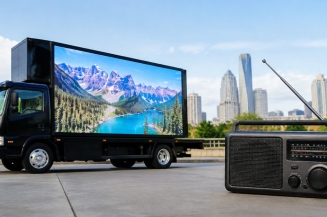
LED Truck Advertising vs Radio Ads: Which Works Better
Quick Summary
LED truck advertising puts a digital screen on a moving vehicle that drives to the audiences a brand wants to reach, showing video and images. Radio advertising delivers audio-only messages through a station’s broadcast to listeners at home, in the car or at work. Choose led truck advertising for local visibility and location-based events, and radio for reaching listeners by format and daypart.
- Mobile LED truck pricing is quoted per campaign, not per impression, and depends on truck count, dates and routes.
- Radio pricing is set station by station and daypart by daypart, often compared using cost per thousand listeners.
- LED trucks can show a product, logo and call to action at once, while radio relies on voice and script alone.
- Measure truck campaigns with promo codes, separate phone numbers, QR codes and route-based tracking.
- Many campaigns combine both, with the truck driving traffic to a location while radio reinforces the offer.
Table of Contents
- How LED Truck Advertising and Radio Ads Work
- LED Truck Advertising Cost vs Radio Ad Costs
- Audience Reach, Targeting and Listening Context
- Mobile Billboard Advertising ROI and How to Measure It
- Radio Ad Script Examples and LED Truck Advertising Examples
- LED Truck Advertising Examples by Campaign Type
- Limitations, Risks and Where Each Channel Falls Short
- Choosing Between LED Trucks, Radio or Both for Your Next Campaign
- Frequently Asked Questions
How LED Truck Advertising and Radio Ads Work
Last Updated: November 7, 2026
LED truck advertising puts a digital screen on a moving vehicle and drives it to the audiences a brand wants to reach. Radio advertising places a spoken or produced message on a station that listeners tune into at home, in the car or at work. Both are paid reach, but they differ in what they show, where they reach people, and how the audience is exposed to the message.
LED trucks display video and still images on large panels. The advertiser chooses the route, the dwell time at fixed locations and the creative rotation. Radio delivers audio only, through a station’s broadcast signal, and the advertiser chooses the station, the daypart and the spot length.
LED Truck Advertising Cost vs Radio Ad Costs
Mobile LED truck pricing is quoted per campaign, not per impression, and the rate depends on the number of trucks, the campaign dates, the routes, the dwell time at fixed locations and any production work on the creative. For a detailed breakdown of what mobile billboard truck campaigns cost and the factors that drive price, see understanding the cost of mobile billboard advertising trucks.
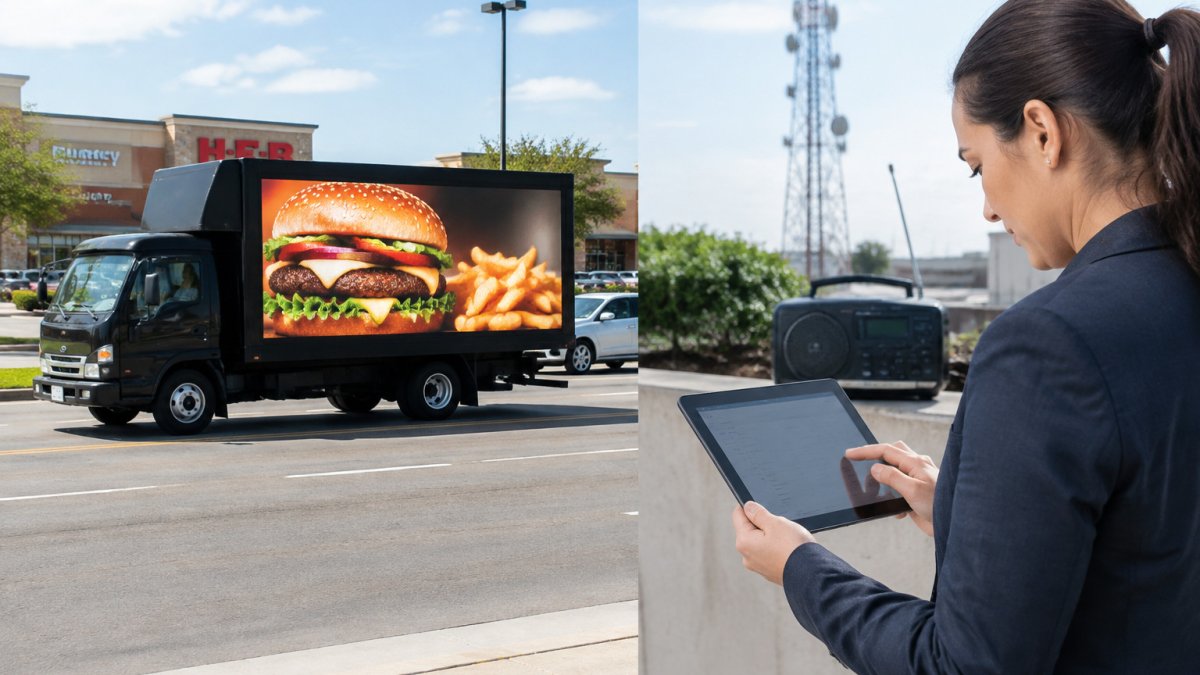
Pricing for mobile LED truck campaigns varies with the number of trucks, dates, routes and production needs, so comparing quotes on identical deliverables is the most useful step.
Radio pricing is set station by station and daypart by daypart, and it moves with market size and audience ratings. Buyers often translate a cost per spot into cost per thousand listeners (CPM) using the station’s rated audience for that daypart.
To compare the two channels honestly, put both on the same four metrics:
- Total campaign cost: truck day rate times days, plus production and any route fees, against spots times rate, plus production and any talent or licensing fees.
- Impressions or listeners: ask the truck operator for the impression methodology behind their estimate, and ask the station for the rated audience for the specific daypart, not the station’s total cume.
- Frequency: how many times the same person is likely to see the truck or hear the spot during the campaign.
- Cost per thousand: total cost divided by impressions (trucks) or by rated listeners (radio), calculated the same way on both sides.
Watch out: a truck’s “impressions” are usually modeled from traffic counts and route length, while radio’s listeners are survey-based ratings, so the two CPMs are not strictly equivalent. Use them to compare orders of magnitude and to sanity-check a quote, not as a precise head-to-head score.
LED trucks can concentrate spend in a specific geography and time window, while radio spreads spend across a broader listening area. For a single-location grand opening, the truck’s cost buys proximity; for a market-wide offer, radio’s cost buys breadth.
Audience Reach, Targeting and Listening Context
Radio reaches people who are already listening. The audience depends on the station format, the time of day and the listener’s activity. A spot during a commute reaches drivers, while a spot during the workday may reach office workers.
A mobile LED truck reaches people in the places the advertiser selects. The route is the main targeting tool for a mobile campaign. A truck parked near a shopping center or driven through a dense commercial corridor puts the message in front of a local audience.
The trade-off is that a truck reaches people who may not be paying attention to it. Radio listeners are often engaged with the content they chose, while drivers and pedestrians are busy with their own tasks. That is why creative must be clear within a few seconds.
Mobile Billboard Advertising ROI and How to Measure It
Neither mobile LED trucks nor radio produce a click, so both are measured by inference. The useful move is to design the campaign so each channel leaves a trace you can count, then compare the traces on the same timeline.
For LED trucks, the practical methods are:
- Promo codes or dedicated landing pages: Put a unique URL or code on the screen and track visits or redemptions by route and date.
- Call tracking: Use a separate phone number for the campaign and count inbound calls during and after each deployment.
- Foot traffic comparison: Compare store visits during the campaign with a baseline period, and note any other promotions running at the same time.
- Route-based tracking: Record the locations, dates and hours of each deployment and compare results by area, so a strong week can be tied to a specific route rather than to the campaign as a whole.
- QR codes held on screen: A code displayed for several seconds at a stop gives pedestrians and nearby drivers a scan path that is attributable to that location.
For radio, the comparable methods are:
- Unique vanity numbers or promo codes: Stations can read a campaign-specific number or code, which separates radio response from other channels.
- Station-supplied ratings: Use the rated audience for the specific daypart and station as the denominator for cost per thousand.
- Ask-for mentions: A “mention this ad” offer at the point of sale gives a rough count of radio-driven visits.
- Post-campaign surveys: Ask new customers how they heard about the business, and keep the question consistent across campaigns.
Watch out: attribution is never perfect on either channel. For practical steps on tracking and analyzing mobile billboard campaign performance, start with the methods above and apply them to each deployment.
A decision framework helps more than a single ROI number. If the goal is awareness in a defined area, measure reach and frequency against the route or daypart you bought. If the goal is event attendance, measure RSVPs, scans and door counts against the campaign window.
The article compares how each channel can be measured, using methods that leave a countable trace.
| Channel | Measurement method | Key limitation |
|---|---|---|
| LED truck | Promo code or landing page | Tracks visits by route and date |
| LED truck | Separate campaign phone number | Counts calls during and after deployment |
| LED truck | QR code shown on screen | Scans attributable to that location |
| Radio | Unique vanity number or promo code | Separates radio response from other channels |
| Radio | Station-supplied rated audience | Sets the denominator for cost per thousand |
| Radio | Post-campaign customer surveys | Relies on customers recalling the source |
Radio Ad Script Examples and LED Truck Advertising Examples
Radio scripts must carry the full message in audio. A typical 30-second restaurant spot might open with the location and the offer, name the restaurant twice and close with a clear next step, such as a phone number or a website. The script should avoid long lists of details, since listeners cannot scan them.
LED truck content works differently. Short lines, large logos and one clear call to action are more effective than long copy. Examples include a single offer shown on a rotating screen, a product image held for several seconds, or a store address and a QR code during a grand opening. Creative can be updated between stops, which allows the message to change with the event or the time of day.
LED Truck Advertising Examples by Campaign Type
Grand openings: A truck parked outside a new store can show the opening date and an introductory offer, then drive to other nearby locations.
Music festivals and sports events: Trucks can circulate near entrances and parking areas, showing schedules, sponsor messages or ticket offers. For more examples, see five billboard trucks that are winning OOH campaigns.
Political and issue campaigns: Mobile screens can show a candidate’s message along busy routes in a specific district, with creative changed as the campaign moves through different neighborhoods. See how an effective LED billboard truck is used in a political campaign for a real example.
Healthcare and clinic promotions: A truck can promote a new service or clinic location in the neighborhoods the clinic serves. Healthcare messaging should follow the rules for medical advertising and avoid claims the clinic cannot support.
Restaurant promotions: Trucks can drive routes near lunch crowds or venues during events, promoting a limited-time menu or a delivery offer.
Limitations, Risks and Where Each Channel Falls Short
Mobile LED trucks have real limits. They depend on traffic patterns, weather and local rules about where vehicles may park or drive. Screen brightness can be hard to read in direct sunlight, and a truck can only reach the areas it visits.
Radio has its own limits. Audience ratings are estimates, and listeners can switch stations or skip ads on streaming platforms. Radio cannot show a product, a location map or a visual brand identity. It also reaches a broad audience, which may include people outside the service area.
Neither channel suits every goal. Mobile LED trucks work best for local awareness, event promotion and reaching people in specific places. Radio works best for reaching listeners by format, time and region. Many campaigns combine both, with the truck driving the audience toward a location and radio reinforcing the offer.
Choosing Between LED Trucks, Radio or Both for Your Next Campaign
Choose LED truck advertising when the goal is local visibility, a grand opening, an event or a campaign that depends on being seen near a specific location. Choose radio when the goal is reaching listeners in a particular market by format or daypart, and when the message can be communicated by voice alone.
Choose both when the campaign needs to reach people at home or in the car and also put a visual message in front of people near the business. Before choosing, review the types of mobile billboards and their associated costs.
Before you decide, define the campaign objective, the target area, the budget and the way you will measure results. Contact Us Now for a Free Consultation to discuss how a mobile campaign would fit your next launch or promotion.
Frequently Asked Questions
Is LED truck advertising more effective than radio advertising?
It depends on the goal. LED truck advertising puts a visual message in front of people in traffic and at events, where it can be seen rather than skipped or turned off. Radio reaches listeners by station, daypart and format, and works well for repeated audio messages. Neither channel is universally better. Compare reach, cost per impression and the decision you want the audience to make, then test both on a small scale to see which generates more measurable response in your market.
How do LED truck advertising and radio ads compare in cost?
Costs vary widely by market, duration, frequency and production needs, so no single figure applies to every campaign. Mobile LED truck campaigns are often priced per day, though actual quotes depend on quantity, dates, routes and scheduling. Radio costs depend on station, daypart and spot frequency. Request itemized quotes from both channels and compare cost per estimated impression, not just the headline rate.
How do you measure the ROI of an LED advertising truck campaign?
Start with a clear goal and a baseline. Track foot traffic or visits near the route or event, use unique promo codes or landing-page URLs tied to the campaign, and compare sales or inquiries in the campaign window against a comparable period without it. Use the same measurement approach for radio, such as unique phone numbers or coupon codes per station. Campaign ROI is the revenue attributable to the campaign minus its cost, divided by its cost, and attribution will always be an estimate.
When should a business choose radio ads over mobile billboard advertising?
Radio is often the better choice when the message is audio-driven, when you need frequent repetition across a region, or when your audience is reached through specific listening habits such as commuting. Mobile LED trucks suit location-specific promotions, grand openings, events and campaigns that need visual impact in high-traffic areas. Many businesses use both, with the truck driving awareness near locations and radio reinforcing the offer.
