

Is Outdoor Advertising Worth It for Multi-Location Businesses?
Quick Summary
Outdoor advertising is worth it for multi-location businesses when each store has a clear goal, a matching format and a measurement plan. It builds local recognition where customers live, work and drive, which helps new locations feel familiar quickly. Results are harder to track than digital ads, so measurement must be planned before launch.
- Use a location-by-location planning template listing each store’s goal, format, audience and success metric.
- Set a coverage floor for every location, then weight extra spend by store performance and growth goals.
- Keep a fixed test reserve for trying new formats or markets before distributing the rest of the budget.
- Use two measurement methods together, such as unique codes plus lift comparisons against similar stores.
- Compare campaign periods carefully, since holiday or promotion months can distort results.
Table of Contents
- Why Outdoor Advertising Works for Multi-Location Businesses
- Outdoor Advertising Ideas for Local Businesses
- Step 1: Build a Location-by-Location Planning Template
- Step 2: Geotargeted Advertising for Multiple Locations
- Step 3: Multi-Location Billboard Marketing Strategy and Budget Allocation
- Step 4: Keep Brand Consistent While Localizing Creative
- Step 5: Measure Outdoor Advertising Campaign Results
- Start Your First Multi-Location Outdoor Campaign
- Frequently Asked Questions
Is Outdoor Advertising Worth It for Multi-Location Businesses?
Last Updated: November 10, 2026
Why Outdoor Advertising Works for Multi-Location Businesses
Outdoor advertising is a strong option for businesses with several locations because it reaches people where they live, work and drive. A message that repeats across neighborhoods builds local recognition faster than a message that lives in one place. See how multiple advertising trucks can amplify reach for a multi-location business.
The core advantage is coverage. A single billboard or advertising truck reaches one trade area at a time. When a chain places units across several markets, each location gets its own visible presence, and the brand looks established everywhere it opens.
Here is what makes outdoor advertising work well for multi-location businesses:
- Local reach: Each market gets a message tied to nearby traffic patterns.
- Visibility that radio and TV cannot match: Ads sit in the physical path of drivers and pedestrians.
- Brand recognition across markets: Repeated exposure makes a new location feel familiar.
- Flexible timing: Campaigns can start, stop or move between locations as openings and promotions change.
Outdoor advertising is not a fit for every goal. It works best for awareness, store launches and event promotion. Tracking direct sales is harder, which is why measurement planning matters from the start. We cover that in the steps below.
Outdoor Advertising Ideas for Local Businesses
Local businesses can use outdoor advertising in several practical ways. The right idea depends on the store, the audience and the budget.
A common approach is a grand-opening campaign. Explore mobile billboard strategies for local businesses that you can adapt to your own neighborhoods. A mobile unit circles the trade area for the first few weeks after a new location opens, announcing the address and an opening offer.
Other ideas that work well for local brands include:
- Promoting weekend specials near high-traffic corridors
- Supporting seasonal menus or product launches
- Driving awareness for a new service line in one city
- Announcing community events hosted at a specific location
Each idea should name a clear local action, such as a visit, a call or a redeemed offer, so the reader knows what to do next.
Billboards, Digital Out-of-Home, and Mobile Units
Three main formats serve multi-location campaigns. Fixed billboards offer long, steady exposure at set spots. Digital out-of-home (DOOH) screens rotate messages and can update creative quickly. Mobile units, such as LED trucks or glass-walled display vehicles, move to the audience instead of waiting for the audience to pass.
Mobile units suit businesses that want to test new markets. Learn the steps, costs, and tips for starting a mobile billboard truck business before committing to a fleet. Fixed billboards suit brands with a permanent presence in one area. Many multi-location brands combine formats, using fixed boards in core markets and mobile units to cover new openings.
Choosing the Right Format for Each Location
Match the format to the location’s job. A high-volume store on a busy highway may justify a fixed board. A new store in an unfamiliar neighborhood may do better with a mobile unit that can circle the area for several weeks.
Use these questions to decide:
- How much traffic passes the site each day?
- Does the store need awareness, or does it need immediate visits?
- How long will the campaign run?
- Can the creative be updated without new printing?
Step 1: Build a Location-by-Location Planning Template
Start with a single planning sheet that lists every location in the campaign. Each row should capture one store and its goals.
Use these columns:
| Location | Goal | Format | Audience | Start Date | Budget Share | Success Metric |
|---|---|---|---|---|---|---|
| Store A | New-store awareness | Mobile unit | Local families | Week 1 | 30% | Store visits |
| Store B | Seasonal promo | Digital board | Commuters | Week 3 | 25% | Coupon redemptions |
| Store C | Brand reinforcement | Fixed billboard | Highway drivers | Week 1 | 45% | Web traffic |
Budget Share
Fill in the template for every location before you choose vendors or creative. This keeps each market’s plan separate and easy to review.
Step 2: Geotargeted Advertising for Multiple Locations
Geotargeting tells you who to reach in each market. For outdoor advertising, that means choosing placements near the people most likely to visit the store.
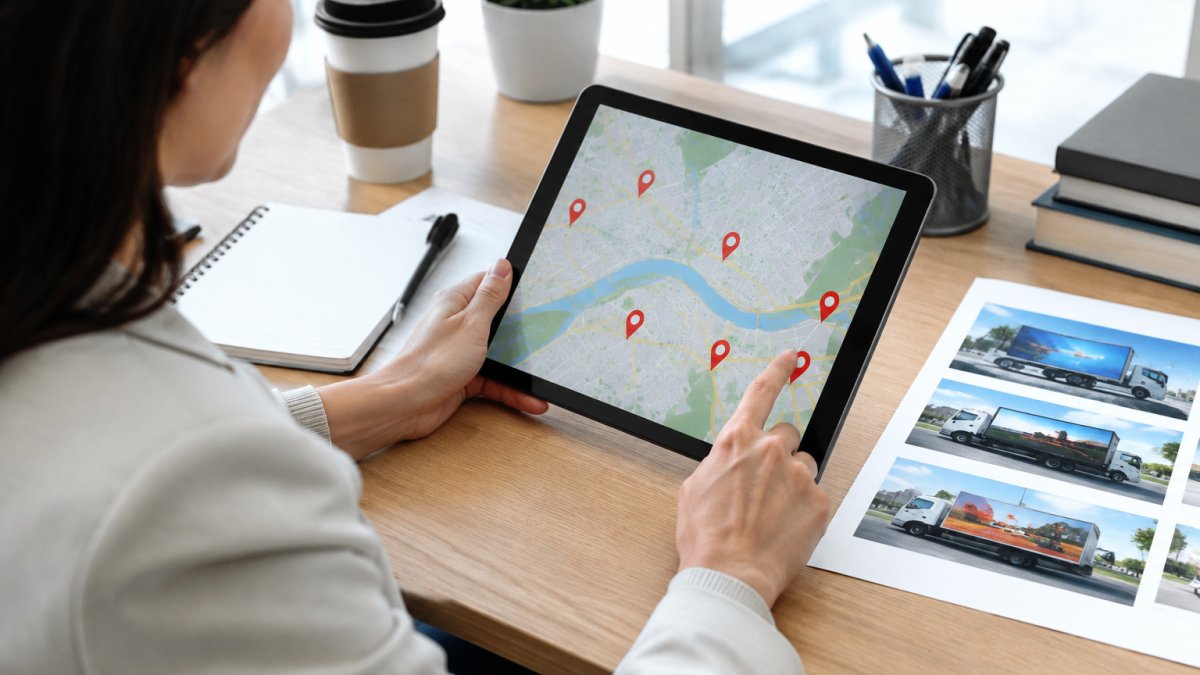
Start with a map of each store’s trade area. Mark main roads, shopping centers and neighborhoods within a short drive. Then match each placement to the audience in that zone.
Keep these points in mind:
- Use local traffic counts where you can get them, not general averages.
- Adjust creative to reflect the neighborhood’s needs.
- Avoid placing identical messages in markets with very different audiences.
Geotargeting works best when each location has its own plan rather than a copy of the last one.
Step 3: Multi-Location Billboard Marketing Strategy and Budget Allocation
Budget allocation is where most multi-location outdoor plans either spread money too thin or concentrate it in the wrong places. The goal is to balance two pressures: keeping a minimum brand presence in every market, and directing extra spend to the locations where it can change outcomes.
A practical framework separates the budget into three layers.
- Coverage floor: A baseline amount that every active location receives so the brand looks present and consistent. This is set by the cost of the cheapest format that still delivers meaningful exposure in that trade area, not by revenue.
- Performance weighting: Additional spend allocated according to store performance and growth goals. A store with strong sales but a saturated market may need less, while a new store in an underpenetrated trade area may need more.
- Test reserve: A fixed slice, often a small share of total spend, kept for testing a new format, a new market, or a different creative approach.
Market size and media cost change the math. A large metro market may have far more impressions per dollar on digital screens but higher absolute prices, while a smaller town may offer a fixed board at a lower price with a larger share of its traffic passing the site. Compare cost per estimated impression within a trade area rather than comparing raw prices across markets, and be explicit about whether the estimate comes from the vendor, a traffic count, or a planning assumption.
A simple working sequence:
- Set the coverage floor using the cheapest viable format in each market.
- Rank locations by business goal and recent store performance.
- Distribute the remaining budget using those rankings, capping any single location so one market cannot absorb the whole plan.
- Hold the test reserve back before distributing the rest.
- Review after the first cycle and shift money toward locations where the success metric moved.
Watch out: Equal splits look fair but usually underfund the stores that need the most help and overspend on markets that are already saturated.
Production and installation costs belong in the same model. Vinyl wraps, LED content, permits where required, and installation labor can change the effective cost of a short campaign, so request quotes that itemize these items separately. Pricing depends on quantity, dates, and delivery, so ask Texas Mobile Advertising for a current quote tailored to each location.
Step 4: Keep Brand Consistent While Localizing Creative
Brand consistency means the logo, colors, fonts and core promise stay the same everywhere. Localization means the headline, offer and image can change to fit each market.
Build one master creative kit with approved logos, color codes and fonts. Then create short local variants that change only the offer, the store address or a local image.
This approach keeps the brand recognizable while letting each store speak to its own neighbors. Learn how to blend outdoor advertising with your digital marketing strategy so messaging stays aligned across channels. A driver who sees the same look in two cities should trust the brand in both places.
Step 5: Measure Outdoor Advertising Campaign Results
Measurement is the hardest part of outdoor advertising because exposure happens in the physical world and conversions happen later, often in a store. The aim is not perfect attribution but a consistent method that shows whether a location’s campaign moved visits or sales more than its normal trend.
Set up measurement before the first creative goes up. Choose one primary metric per location and track it the same way across all stores.
Several methods connect outdoor exposure to outcomes:
- Unique URLs, QR codes, and phone numbers: Assign a separate landing page or number to each location or format. This works best for direct-response offers and gives a clean count of responses, though it captures only people who act on the ad.
- Location-specific offer codes: Print a code that is valid only at one store. Redemption counts show how many shoppers came in response to that campaign.
- Point-of-sale and loyalty data: Match store transactions or loyalty sign-ups to the campaign window, and compare the same metric in a comparable period without the campaign.
- Lift analysis: Compare the campaign location’s store traffic or sales against a similar store or trade area that did not run outdoor advertising during the same period. Matching stores on size, prior performance, and local conditions makes this comparison more credible.
- Location analytics: Where available, use anonymized foot-traffic or device-based visit data to see whether visits to the store rose during the flight, keeping in mind the privacy and data-quality limits of these sources.
No single method is complete. Unique codes undercount people who see the ad and visit without redeeming anything, while lift comparisons are noisy in small markets. Using two methods together gives a more reliable picture than either alone.
Read results against the planning template’s success metric for each location. See a real digital advertising truck campaign with results for Griffin Roofing as an example of measured impact.
Watch out: Comparing a campaign month against a holiday or promotion month in the prior year can make results look better or worse than they are, so match comparison periods carefully.
Plan a review after each campaign cycle. Consistent measurement across markets makes comparisons fair and gives you a basis for the next round of planning.
Start Your First Multi-Location Outdoor Campaign
Outdoor advertising can work well for multi-location businesses when each store has a clear goal, a suited format and a way to measure results. Texas Mobile Advertising has completed more than 1,400 advertising vehicle campaigns, and the team can help you match mobile and digital units to your store openings and promotions.
Start by filling out the planning template for your locations. Then bring it to a consultation so the team can recommend formats and a budget plan for each market. Contact Us Now for a Free Consultation.
Frequently Asked Questions
What is the 3-3-3 rule for marketing?
The 3-3-3 rule is a simple framework that suggests planning marketing around three audiences, three channels, and three messages at a time. For multi-location businesses, it helps keep outdoor campaigns focused. Choose three locations or trade areas to start, three formats such as a static billboard, a digital screen, and a mobile unit, and three core messages that stay consistent across sites. Limiting scope this way makes it easier to measure results and adjust before expanding to more markets.
How do you coordinate outdoor advertising across multiple locations?
Coordination starts with a single planning sheet listing each location, its trade area, available outdoor inventory, the campaign start and end dates, and the budget assigned. Assign one owner to approve creative and placements. Use a shared calendar so local teams know when units are scheduled to arrive and run. Review performance weekly and shift spend toward the sites showing the strongest store visits or call volume.
How can you measure whether outdoor advertising drives store visits?
Use a mix of methods because no single one captures every visit. Set a baseline of store traffic or inquiries for each location before the campaign starts. Use location-specific phone numbers, promo codes, or landing page URLs printed on the creative. Compare results against sites without outdoor support where possible. Track changes in foot traffic and sales over the campaign window to estimate lift at each location.
