
Best Strategies for Local Store Launches in Texas
Last Updated: November 28, 2026
Quick Summary
The best local store launches combine a timeline with named owners and deadlines starting eight to twelve weeks out, a mobile and local media push timed to opening day, a grand opening event that draws visitors in week one, and post-opening tracking of door count, conversion, and repeat visits. Budget depends on days, locations, and asset type, so request a quote for your specific plan.
- Start the pre-launch timeline eight to twelve weeks before opening day, with one named owner per task.
- Set every deadline at least two weeks before opening day so slipped dates do not reach the launch.
- Start the signage permit track in week 12, since permits usually take longer than vendors quote.
- Track door count, conversion rate, and repeat-visit rate weekly after opening to measure the launch.
- Keep a contingency budget of roughly ten to fifteen percent of launch spend for a weak opening.
Table of Contents
- How Much Does a Local Store Launch Campaign Cost?
- Building a Pre-Launch Timeline With Owners and Deadlines
- Grand Opening Ideas for Retail Store Launches
- Running a Store Opening Campaign Across Local Media
- Sending a Shop Opening Invitation That Gets Opened
- Retail Store Foot Traffic Strategies After Opening Day
- Scheduling Your Local Store Launch Next Steps
- Frequently Asked Questions
How Much Does a Local Store Launch Campaign Cost?
A local store launch campaign costs whatever the mix of tactics requires, and pricing depends on quantity, dates, delivery and the number of locations involved. Texas Mobile Advertising does not publish fixed rates here, so the most useful step is to request a quote for your specific plan. Visit texasmobileadvertising.com for current pricing details.
Budget decisions usually come down to three questions: how many days you need visibility, how many locations you are covering, and whether you need a single mobile asset or a rotation across several neighborhoods. Build your estimate around those variables before you compare any proposal side by side.
Watch out: Comparing a quote for one week against a quote for one month can make a cheap option look expensive. Ask every vendor to price the same dates, the same geography and the same number of impressions.
Building a Pre-Launch Timeline With Owners and Deadlines
A workable launch timeline starts eight to twelve weeks before opening day and runs on a single shared table with four columns: week, task, owner, and done-by date. For the broader set of store-launch strategies that drive traffic, see how the timeline fits the full plan. The owner is one named person, not a department, because a shared task with two owners is a task nobody finishes. Set every deadline at least two weeks before opening day so a slipped date does not cascade into the launch itself.
A common pattern for a twelve-week runway looks like this:
- Weeks 12-10, site and legal. Confirm the certificate of occupancy path, sign permits, and any health or fire inspection scheduling with the local permitting office. Owner: operations lead. Done-by: week 10.
- Weeks 10-8, marketing commitments. Lock the outdoor and mobile media schedule, order signage and window graphics, and reserve any grand-opening date with vendors. Owner: marketing lead. Done-by: week 8.
- Weeks 8-6, local listings and search. Claim or update the Google Business Profile, Apple Business Connect listing, and map pin; verify the address, hours, phone number, and category; upload exterior photos. Owner: marketing lead. Done-by: week 6.
- Weeks 6-4, hiring and training. Complete hiring, schedule training shifts, and confirm the opening-week labor schedule against projected traffic. Owner: store manager. Done-by: week 4.
- Weeks 4-2, inventory and systems. Receive opening inventory, test the point-of-sale and card processing, and run a full dry-run transaction. Owner: operations lead. Done-by: week 2.
- Weeks 2-0, final checks. Walk the store for accessibility (entry width, aisle clearance, restroom access), confirm staffing for the busiest hour rather than the average, and brief the team on crowd flow and opening-day roles. Owner: store manager. Done-by: opening day minus three days.
Two dependencies cause most launch delays. First, signage and exterior work usually require a permit that takes longer than the sign vendor quotes, so start that track in week 12 even if the interior build is still running. Second, the map listing will not verify until the address is final and the phone is live, so treat listing verification as a hard gate rather than a marketing afterthought. Once the address and exterior work are settled, keep the storefront presentable as opening day approaches, with Lone Star Exterior Pressure Wash part of the final readiness plan.
Watch out: A timeline that lists tasks without owners and done-by dates turns into a wish list. Review the table in a fifteen-minute weekly stand-up and move any missed date to a new owner and a new date the same day, or the slippage compounds silently until the week before opening.
The pre-launch work is easier to track when each phase has a clear owner and deadline.
| Weeks before opening | Focus | Owner |
|---|---|---|
| 12-10 | Site and legal permits | Operations lead |
| 10-8 | Marketing commitments and signage | Marketing lead |
| 8-6 | Local listings and search | Marketing lead |
| 6-4 | Hiring and training | Store manager |
| 4-2 | Inventory and systems testing | Operations lead |
| 2-0 | Final checks and staffing | Store manager |
Grand Opening Ideas for Retail Store Launches
Grand opening events work best when they give people a reason to visit in the first week. Common options include a ribbon cutting with local officials, a product demonstration, a giveaway tied to store visits, and a limited opening-day offer. Many retailers pair one headline event with several smaller daily promotions.
Choose ideas that match your merchandise. A demonstration works well for products people want to try. A sampling table fits food and beverage. Whatever you choose, plan staffing for the busiest hour, not the average one.
Running a Store Opening Campaign Across Local Media
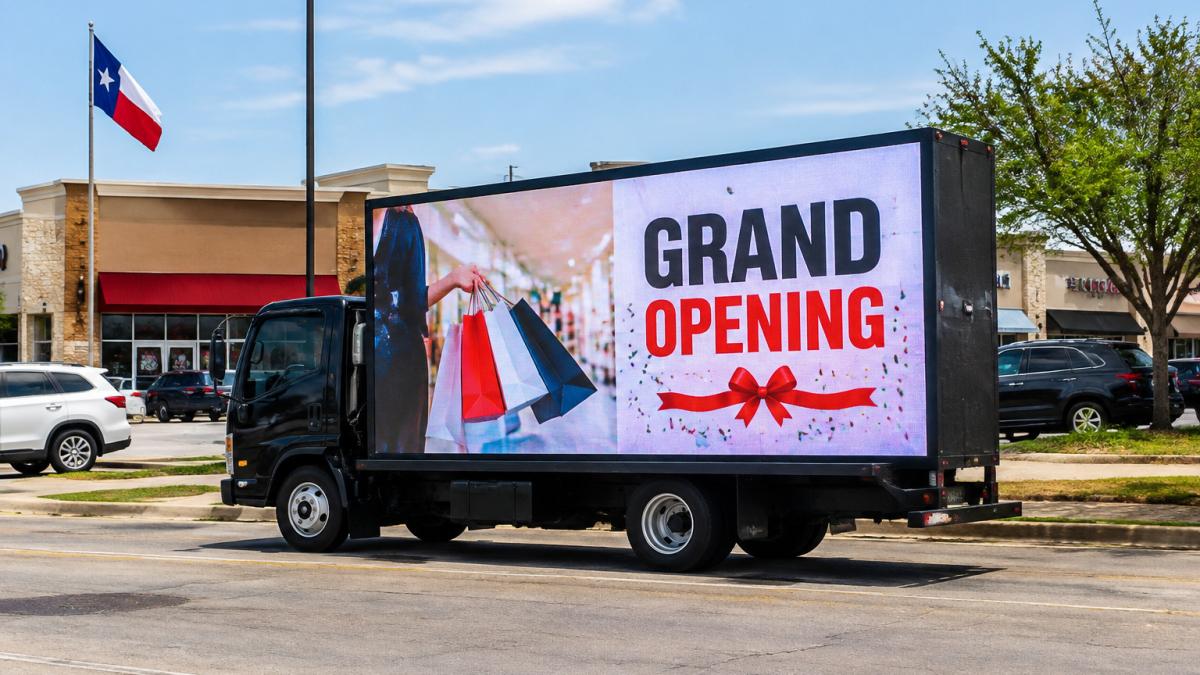
A store opening campaign needs to reach people who are close enough to visit this month. Mobile advertising suits that goal because the vehicle can drive past your new location and move through neighborhoods where your customers live and shop. Texas Mobile Advertising offers LED digital trucks and glass-walled display vehicles for this kind of short, local push.
Pair mobile placements with social posts and local listings so the same message reaches people more than once. Repetition across channels usually does more than a single large spend on one medium.
Sending a Shop Opening Invitation That Gets Opened
An opening invitation has one job: get the reader to act before the date passes. Keep the subject line specific, such as the store address and the opening day. Include one clear reason to attend, such as an opening-day discount or a demonstration time, and one clear action, such as saving the date or claiming a coupon.
Send the invitation to people who already know your brand, including email subscribers and loyalty members, and follow up once with a shorter reminder. Track opens and clicks so you know which message worked for the next location.
Retail Store Foot Traffic Strategies After Opening Day
Opening day is only the start. The weeks that follow decide whether the launch produced a store or a spike, and the difference is usually a measurement loop rather than a bigger spend. Build that loop before opening day so the first week of data is usable.
Set a baseline and three numbers. Before opening, record the campaign spend by channel (mobile media, social, email, local print) and the dates each ran. After opening, track three numbers weekly: door count (from a people counter or point-of-sale transaction count if no counter is installed), conversion rate (transactions divided by door count), and repeat-visit rate (customers with more than one visit in the first thirty days, pulled from loyalty or card data). A common pattern is that door count peaks in week one, conversion holds steady, and repeat visits are the number that predicts whether the store survives past month three.
Connect spend to traffic, not to impressions. For each channel, divide the week’s spend by the incremental door count over the prior week’s baseline. That gives a rough cost per visit, which is the number that lets you compare a mobile campaign against a social campaign honestly. If a channel’s cost per visit rises for two consecutive weeks, redeploy that budget rather than renewing it out of habit.
Use the first-week pattern to time the second push. A sharp drop from opening-day peak to week two usually means the next wave of promotion needs to start sooner than planned. Campaigns can be redeployed to new neighborhoods when a location needs a second push, and the same measurement loop tells you whether the second push moved door count or only impressions.
Plan for low turnout before it happens. Keep a contingency budget of roughly ten to fifteen percent of launch spend for a weather-affected opening, a supply delay, or a weak first weekend. The backup play is usually a short-notice mobile push and a rescheduled event rather than a discount, because discounting the opening week trains early customers to wait for the next sale.
Cross-promote with nearby businesses on a schedule, not a handshake. Agree on specific dates and specific offers with two or three neighboring businesses, and track redemptions so you know which partnership actually sent people. Recurring small in-store events work best when they are tied to a measurable offer rather than held for their own sake.
Watch out: Measuring visits without measuring conversion and repeat visits hides the real problem. A store can hit its door-count target and still fail if the first-week visitors never come back, so review all three numbers together before deciding where the next dollar goes.
Scheduling Your Local Store Launch Next Steps
Start by setting your launch date and the owner for each track, then request a quote from Texas Mobile Advertising for the mobile campaign you have in mind. A consultation helps you compare the options against your timeline and budget before commitments are made. Contact Texas Mobile Advertising for a free consultation and a plan built around your opening.
Frequently Asked Questions
What are some effective ideas for a store grand opening?
Effective grand opening ideas include a ribbon-cutting with local officials, opening-week discounts for early visitors, live product demonstrations, and a giveaway that requires an in-store visit to enter. Pair these with local advertising such as mobile billboard trucks in the weeks before opening. Pricing for mobile advertising depends on quantity, dates, and delivery, so request a quote from Texas Mobile Advertising for current rates. Track each tactic separately so you know which ones drove visits.
How far in advance should a store opening campaign start?
Most launch campaigns should begin four to six weeks before opening day. The first two weeks focus on awareness, using local advertising, social media, and community outreach to reach people nearby. The final week shifts to reminders, grand opening invitations, and event details. Starting earlier gives you time to adjust messaging based on early response and to confirm that permits, signage, and staffing are ready.
How can a new retail store attract more foot traffic?
A new store attracts foot traffic when people know it exists and have a reason to visit. Combine outdoor advertising near the location with a clear opening offer and a local partnership, such as a nearby business cross-promotion. Claim and complete your Google Business Profile so the store appears in local search. Outdoor advertising can drive attention to the site during launch weeks, though results vary by market and should be measured with promo codes or visit tracking.
