
Strategies for New Retail Store Launches That Drive Traffic
Last Updated: November 19, 2026
Quick Summary
Successful new retail store launches depend on a single timeline with one named owner per task and decision gates that release spend only when readiness criteria are met. Validate local demand within a defined trade area before signing a lease, then build a budget with a 90-day operating reserve and a break-even target.
- Assign one accountable owner to each launch phase rather than a committee.
- Set decision gates for lease signing, build-out approval, and marketing spend, each with listed criteria.
- Estimate demand bottom-up from trade-area households, penetration rate, and average annual spend.
- Hold a 10 to 15 percent contingency and cover at least 90 days of operating costs at conservative forecast.
- Start pre-opening promotion four to six weeks before opening and intensify in the final week.
Table of Contents
- Building a Launch Timeline With Owners and Decision Gates
- Validating Local Demand and Choosing the Site
- Launch Budget, Cash Flow, and Break-Even Planning
- How to Promote a New Store Opening Before the Doors Open
- Local Advertising Ideas for Retail Stores That Drive Foot Traffic
- Retail Soft Opening Ideas and the Grand Opening Checklist
- Measuring Launch KPIs and Optimizing the First 90 Days
- Frequently Asked Questions
Building a Launch Timeline With Owners and Decision Gates
A new store opening succeeds or fails on sequencing, and every new retail store launches with the same timing risk. Most new retail store launches that slip do so because one team waited on another, not because the idea was weak.
Start with the opening date and work backward. Lease commencement, build-out, fixture delivery, inspections, hiring, inventory receipt, and marketing all need fixed deadlines. Each item should have one accountable owner, not a committee.
Assigning owners for each phase
Divide the launch into phases: planning, site readiness, pre-opening promotion, soft opening, and grand opening. Assign one owner per phase, such as an operations lead, a marketing lead, and a store manager for staffing and inventory. A common mistake is spreading ownership across a group, which leaves no one responsible when a deadline slides.
Setting decision gates before you commit spend
A decision gate is a checkpoint where the team confirms readiness before money is released. Set gates for lease signing, final build-out approval, and marketing spend. Each gate should list the criteria that must be met, such as permits approved or inventory confirmed. Gates protect the budget and give leadership a clear point to pause if a dependency fails.
Validating Local Demand and Choosing the Site
Site selection should rest on evidence of local demand, not gut feel. A trade area is the geographic zone from which most of a store’s customers will come. Define it by drive time and population density, then test whether the demand for your products exists inside that zone.
A practical way to size the trade area is to draw two rings: a primary ring of roughly a 5- to 10-minute drive and a secondary ring of 10 to 15 minutes, adjusting for density and traffic patterns. Most of your repeat business will come from the primary ring, so weight your demand estimate accordingly. If your concept depends on destination trips rather than convenience, widen the rings and treat the secondary ring as your real market.
Estimating demand before you sign a lease
Build a bottom-up sales forecast rather than a top-down market-share guess. The mechanism is straightforward: estimate the number of households in the trade area, apply a realistic penetration rate (the share of those households that would buy from you in a year), multiply by your average annual spend per customer, and divide by 12 for a monthly figure.
Use public and low-cost data sources to ground the estimate, such as census tract population and household income data and local business license filings.
Scoring candidate sites
Score each candidate on a short, weighted list so the decision is defensible:
- Trade-area households and income fit
- Traffic counts and visibility from the main road
- Parking ratio and ease of entry and exit
- Co-tenancy: which nearby stores already draw your shopper
- Rent per square foot against forecast sales
- Zoning and permitted use confirmed with the local planning office
Watch out: a site with strong traffic but poor ingress and egress can underperform a quieter site that is easy to enter, so count turns and test the actual drive-in during peak hours before you commit.
Testing demand cheaply before launch spend
You do not need a signed lease to validate demand. Run a pop-up, a farmers-market booth, or a local advertising campaign in the trade area and measure sign-ups, offer redemptions, and conversations. A few weeks of low-cost testing can confirm whether the shoppers you forecasted actually respond, and it gives you real conversion data to refine the forecast before build-out money is committed.
Launch Budget, Cash Flow, and Break-Even Planning
Most launch guides stop at tactics. The launch budget is where a new store actually succeeds or fails, so build it in three layers: fixed costs (rent, build-out, equipment), opening costs (inventory, hiring, training, initial marketing), and operating reserves for the first 90 days. Revenue often takes months to reach a steady level, so cash flow planning matters more than the first-month sales forecast.
Line items to include in each layer
Fixed costs typically include first and last month’s rent, security deposit, tenant improvements, fixtures, POS hardware, signage, and any build-out overages. Opening costs include initial inventory, recruiting and onboarding, training hours, opening marketing, and grand-opening event expenses.
A common pattern is to underfund the reserve and overfund the build-out. Hold back a contingency of roughly 10 to 15 percent of total launch spend for change orders, permit delays, and fixture replacements, and treat that contingency as untouchable until the store is open and stable.
Cash flow mechanics for the first 90 days
Build a simple weekly cash flow sheet: opening cash balance, cash in from sales, cash out for payroll, rent, inventory replenishment, and marketing, and ending balance. Run it at three scenarios, conservative, base, and strong, and identify the week your ending balance would go negative.
Watch out: inventory replenishment often lands before sales ramp, so the first restock order can be the single largest cash outflow of the launch quarter. Time it against your forecast rather than your opening-week sell-through.
Calculating break-even
Calculate break-even by dividing total fixed costs by your average gross margin per sale. This tells you the monthly sales volume the store must reach to cover its costs.
Compare the break-even target to your trade-area demand forecast. If the forecast sits comfortably above break-even, the site and budget are aligned. If it sits below, either the rent is too high, the margin is too thin, or the demand estimate is too optimistic, and that is the moment to renegotiate or walk away.
Sizing launch marketing against the target
Local advertising spend should be sized against the break-even target, not against a percentage of revenue you have not earned yet. Set a launch marketing budget as a fixed dollar amount for the pre-opening and opening weeks, then measure cost per store visit and cost per transaction against it.
The article breaks the launch budget into three layers and gives the key calculation steps, summarised below.
| Budget layer | What it covers | Planning note |
|---|---|---|
| Fixed costs | Rent, build-out, fixtures, POS, signage | Include first and last month’s rent and deposit |
| Opening costs | Inventory, hiring, training, opening marketing | Restock often lands before sales ramp |
| Operating reserve | Payroll, rent, utilities, vendors | Cover at least 90 days at conservative forecast |
| Contingency | Change orders, permit delays, replacements | Roughly 10 to 15 percent of total launch spend |
How to Promote a New Store Opening Before the Doors Open
Pre-opening promotion builds awareness in the weeks before new retail store launches, when the store is still a construction site. Announce the opening date, reveal a teaser offer, and drive people to a sign-up list or social channel.
Timing matters. Start promotion roughly four to six weeks out and increase intensity in the final week. You can book a mobile billboard for a launch event to put the announcement in front of the trade area while it is still forming its awareness of the new location.
Local Advertising Ideas for Retail Stores That Drive Foot Traffic
The most effective local tactics put the message where people already travel. Mobile billboard trucks can run routes near schools and through commercial corridors that match your customer profile.
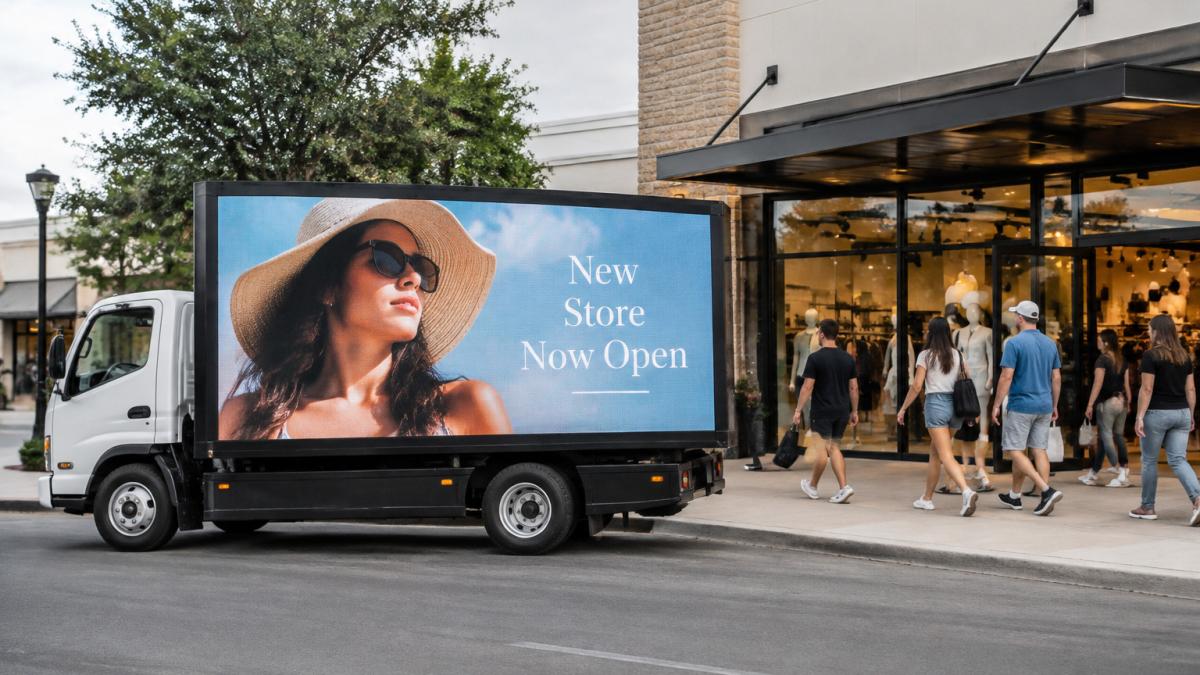
Pair mobile placements with in-store signage that points to the location, and track which routes and days produce store visits. Explore mobile billboard ideas built for retail foot traffic to see how these formats compare for a new location.
Retail Soft Opening Ideas and the Grand Opening Checklist
A soft opening lets the team test operations with a limited audience before the grand opening. Invite staff families, local business neighbors, and loyalty list members. Use this window to check checkout speed, stock levels, and signage visibility.
Use this grand opening checklist:
- Final inspection and permits confirmed
- Staff trained on POS, returns, and safety procedures
- Inventory counted and displays set
- Exterior signage and window graphics installed
- Promotional offer loaded in POS
- Local advertising schedule confirmed
- Emergency contacts and first-aid supplies in place
Measuring Launch KPIs and Optimizing the First 90 Days
Track a short list of launch KPIs: store visits, foot traffic counts, promotional redemption rate, average transaction value, and sales against the break-even target.
Adjust in 30-day reviews. Shift spend toward the routes and offers that produced visits, and cut those that did not. To measure return on mobile placements, see how to calculate mobile billboard ROI for a launch campaign.
Texas Mobile Advertising has completed more than 1,400 mobile billboard advertising vehicle campaigns. Contact Texas Mobile Advertising for a free consultation.
Frequently Asked Questions
What are the most effective strategies for launching a new retail store?
The most effective launches combine three things: a timeline with named owners and decision gates, a pre-opening awareness push aimed at people within a practical driving radius of the site, and a structured soft opening that lets the team fix operational problems before the crowds arrive. Track a small set of launch KPIs from day one, such as foot traffic, average transaction value, and conversion rate, so you can adjust promotions in the first 30 to 90 days rather than guessing. Pricing for any advertising support depends on quantity, dates, and delivery, so request a quote from Texas Mobile Advertising for current figures.
How do you create buzz before a new store opens?
Start promoting two to four weeks before the opening date with a visible, location-specific message. Mobile advertising vehicles can circulate through the trade area around the new site, pairing video or image ads on LED screens with a clear date and offer. Supplement that with social media posts, community partnerships, and a sign-up list for early access. Consistency matters more than volume: a steady run of exposures in the same neighborhoods builds familiarity before the doors open.
What is the difference between a soft opening and a grand opening?
A soft opening is a limited, often invite-only or staff-and-friends trial that lets the team test operations, staffing, inventory flow, and point of sale under real conditions. A grand opening is the public celebration, usually with promotions, events, and heavier advertising, designed to draw the largest crowd. Running a soft opening first reduces the risk of service problems during the grand opening, when traffic is highest and mistakes are most visible to new customers.
How long should a retail store launch campaign last?
Most launch campaigns run from about four weeks before opening through the first 30 to 90 days after. The pre-opening phase builds awareness and collects contacts, the opening weeks convert that attention into visits, and the post-opening phase focuses on repeat customers and optimization. The exact length depends on your trade area, competition, and how quickly your KPIs stabilize, so set decision gates at each stage rather than a fixed end date.
How can outdoor advertising help promote a new store opening?
Outdoor and mobile advertising puts your opening message in front of people who are already moving through the area, which is useful when a store has no existing customer base. Mobile billboard trucks can be routed through specific neighborhoods, near schools, or past competitors, and their LED screens can display video and time-sensitive offers. To judge whether it works, compare foot traffic and promotion redemptions in the trade area during the campaign against your pre-campaign baseline.
How can a new retail store attract local customers?
Focus first on the trade area: the neighborhoods within a realistic driving or walking distance of the store. Use local advertising, community partnerships with nearby organizations, and location-based promotions that give people a reason to visit in their first month. Track where new customers come from by asking at checkout or using promo codes tied to specific channels, so you can shift budget toward the areas and tactics that bring the most visits.
