
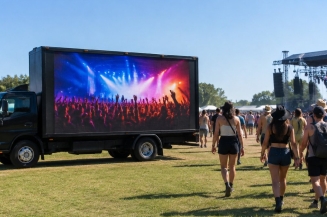
Mobile Billboard Advertising for Music Festivals: A Planning Guide
Last Updated: November 17, 2026
Quick Summary
A mobile billboard is a truck-mounted display that moves through festival crowds, reaching attendees at gates, queues, parking lots and campgrounds. Digital LED trucks suit rotating lineups, while static vinyl trucks suit one bold image. Plan routes around three time windows: arrival, mid-day and departure.
- Digital LED trucks suit rotating lineups, but need power and carry higher daily costs.
- Static vinyl trucks are simpler and often cheaper, suited to a single bold message.
- Start booking several weeks before the festival, then raise frequency in the final days.
- Target arrival gates and ticket queues 2-4 hours before gates open.
- Get the organizer’s traffic control plan before finalizing any route.
Table of Contents
- Why Mobile Billboard Advertising Works for Music Festivals
- Choosing Between Digital LED and Static Vinyl Mobile Billboards
- Mobile Billboard Advertising for Events: Planning Your Festival Campaign Step by Step
- Mapping Mobile Billboard Campaign Routes Around Venues, Crowds and Schedules
- Mobile Billboard Ad Examples and Creative Guidance for Festival Audiences
- What Mobile Billboard Advertising for Music Festivals Costs and What Affects Price
- Permits, Safety and Measuring Results for Your Festival Campaign
- Booking Your Festival Mobile Billboard Campaign With Texas Mobile Advertising
- Frequently Asked Questions
Mobile billboard advertising for music festivals puts your brand on the move, right where festival-goers are walking, queuing and waiting. This guide walks through how to plan a mobile billboard campaign from start to finish. A static poster at a festival gate gets lost in the crowd; a moving display that flows through the same traffic tends to hold attention longer. Below, you will see where mobile billboards fit, how to pick a format, and what a realistic campaign plan looks like.
Why Mobile Billboard Advertising Works for Music Festivals
Festivals concentrate large audiences into a small area for a short time, making them a strong match for a format that moves through the same space. A mobile unit can circle the venue perimeter, park near ticket lines or travel between parking lots, reaching people already in a buying mindset.
The format works best as an awareness and excitement tool, not a direct-response channel, so set expectations accordingly.
Choosing Between Digital LED and Static Vinyl Mobile Billboards
Digital LED trucks show video, animation and rotating messages. To weigh whether this format is worth booking, see whether mobile LED truck advertising is worth booking. They suit lineup announcements, ticket reminders and creative that changes by time of day. The trade-off is that they need power, a driver and a higher budget per day.
Static vinyl trucks carry a large printed image. They are simpler to run, often cheaper, and work well for a single bold message such as a headliner photo or a logo.
| Format | Best for | Main advantage | Main drawback |
|---|---|---|---|
| Digital LED truck | Rotating lineups, video, timed promotions | Motion and flexible creative | Higher daily cost, power needs |
| Static vinyl truck | One strong image, longer routes | Lower cost, simpler setup | No motion or message changes |
| Glass-walled display | Product showcases near entrances | Shows the product itself | Limited reach to moving traffic |
Mobile Billboard Advertising for Events: Planning Your Festival Campaign Step by Step
- Set one goal. Choose awareness, app downloads, ticket sales or merchandise sales; a single goal guides creative and route choices.
- Confirm the festival dates and footprint. Note gate hours, peak arrival times and off-site parking areas.
- Pick the format. Match digital or static to your message and budget.
- Book timing. Many promoters start mobile campaigns several weeks before the festival, then increase frequency in the final days.
- Plan creative. Write the message, confirm file specifications with your vendor, and prepare a call to action such as a short web address or a hashtag.
- Brief the driver. Give a route, a schedule and a clear stopping plan.
Mapping Mobile Billboard Campaign Routes Around Venues, Crowds and Schedules
Route planning is where most festival mobile billboard campaigns succeed or fail. For the practical steps to book a mobile billboard for an event, see how to book a mobile billboard for an event.
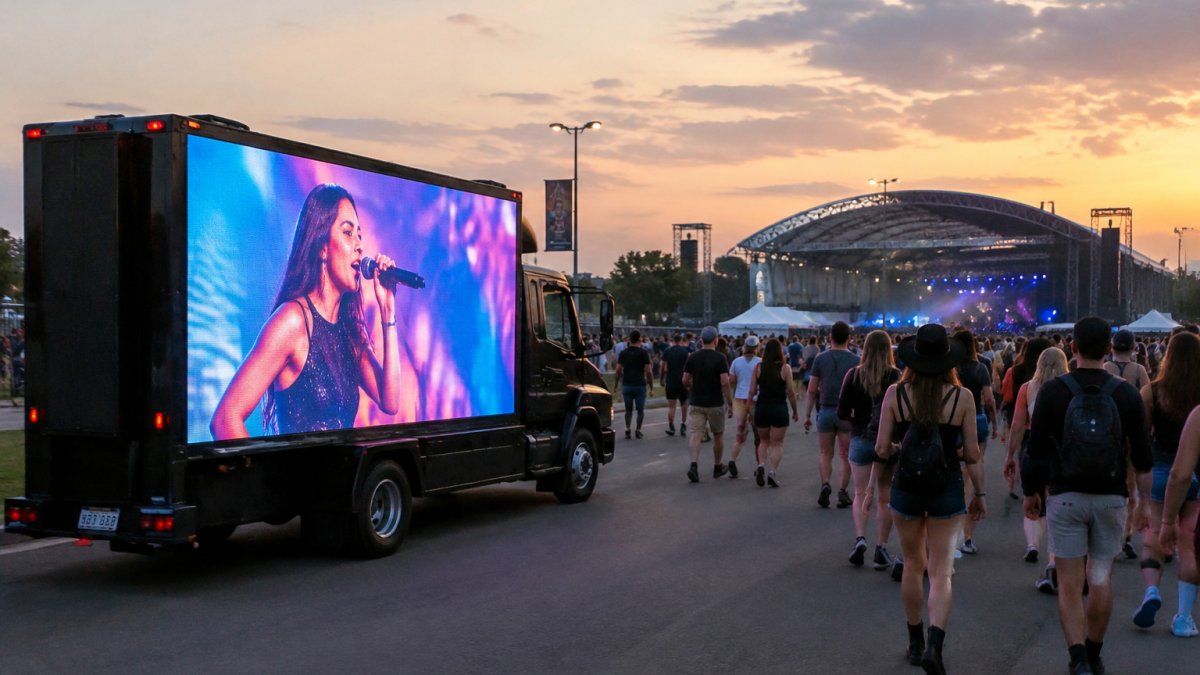
Start by building a simple zone map from the venue’s published site plan and the organizer’s traffic plan, then assign each zone a priority:
- Arrival gates and ticket scan lines, highest density during the two to three hours before gates open and the first hour after.
- Rideshare and shuttle drop-off zones, steady flow from mid-afternoon through the headliner set.
- Day parking lots and overflow lots, heavy in the morning and again at the end of the night.
- Campground entrances and camp store areas, for multi-day festivals, these are active from early morning through late evening and are often underserved by other advertising.
- Nearby nightlife, after-parties, and hotel clusters, useful for late-night passes and for reaching attendees who leave the grounds between sets.
- Perimeter roads with slow or stopped traffic, the truck becomes a stationary billboard whenever traffic backs up, which is free dwell time.
Once the zones are mapped, build the route around three time windows rather than a single all-day loop:
- The arrival window (roughly 2-4 hours before gates). Run the truck along the main approach roads, past the rideshare lot, and along the queue line. Attendees are stationary, captive, and already thinking about the day’s schedule, the best window for lineup and set-time messaging.
- The mid-day window (gates open through late afternoon). Traffic is usually lighter and more dispersed. Use this window for campground loops, shuttle-stop passes, and parking-lot sweeps, and for slower speeds and longer dwell near entrances.
- The departure and nightlife window (headliner set through venue close). Crowds leave in waves. Position the truck near exit roads, rideshare pickup zones, and nearby after-party venues. This window works best for next-day programming, after-party promotions, and merchandise or app calls to action.
- Coordinate with the organizer’s traffic plan, not just the public map. Event-day road closures, one-way conversions, and no-stopping zones are usually published only to vendors and permit holders. Ask the organizer for the traffic control plan before you finalize any route.
- Build in buffer time for gate backups. A route that assumes a 10-minute pass between two zones can take 30 minutes when a gate backs up. Schedule fewer zones per hour than the map suggests.
- Plan for idling and stopping restrictions. Many venues and host cities restrict where a display vehicle can stop or idle. A truck that has to keep moving is a different route design than one that can park for 20 minutes at a time.
- Keep a contingency zone. Weather delays, set-time changes, and gate holds all shift crowd flow. Have one backup zone the driver can move to if the primary zone empties out.
Watch out: routes that look efficient on a map often jam in real event traffic, and a truck stuck in a backup is not reaching anyone new.
Finally, log the route: which zones the truck hit, at what times, and what crowd density looked like.
Mobile Billboard Ad Examples and Creative Guidance for Festival Audiences
Festival creative works best when it is short, bold and easy to read at speed. Use large type, a single headline and high-contrast colors. Show the artist, the date or the offer, and keep secondary details minimal.
- A headliner name or lineup highlight in the largest type.
- A simple date, time or location line.
- A call to action that is easy to act on, such as a short link or a scannable code.
- A consistent color scheme that matches the festival’s own branding and signage.
For digital units, plan loops of six to ten seconds with a clear message in the first two seconds. Test how the content reads from a distance and at night.
What Mobile Billboard Advertising for Music Festivals Costs and What Affects Price
Mobile billboard companies commonly quote per campaign, because cost drivers vary between festivals. You can still build a realistic budget before requesting a quote if you understand what moves the number.
- Format. Digital LED trucks carry higher daily rates than static vinyl trucks because of equipment, power, and operating requirements. Glass-walled display vehicles typically sit between the two depending on the build.
- Number of trucks. Running more than one truck on coordinated routes increases both cost and reach.
- Number of days. Festival campaigns are often planned in a pre-event phase and an on-site phase. Total days affect cost.
- Route complexity. More complex routes can require additional planning time.
- Creative production. Static and digital creative each require production work that may be quoted separately from truck time.
- Permits and approvals. Some host cities and venues require permits or written approval for mobile advertising vehicles, which can add lead time.
- Travel and positioning. Distance to the festival can affect the overall quote.
- Measurement setup. Dedicated landing pages, unique promo codes, and QR codes should be budgeted as a line item.
A practical way to structure a festival budget is to think in tiers based on campaign scope rather than a single headline rate:
When budgeting, consider spend across several categories rather than only the truck rate:
- Truck time and route execution, usually the largest line item.
- Creative production, print or digital file prep, plus any design work.
- Permits and approvals, fees and any application support.
- Measurement, landing page, promo code setup, and reporting time.
Marketers often under-budget creative and measurement and then wonder why the campaign is hard to evaluate.
Watch out: a quote that looks low on the headline rate may exclude other line items, so compare the full scope of each proposal.
Texas Mobile Advertising has not published standard rates in this guide, so pricing depends on your specific quantity, dates, route plan, and delivery requirements. To judge whether the spend pays off, read how to measure mobile billboard ROI.
Permits, Safety and Measuring Results for Your Festival Campaign
Before the truck moves, confirm the rules that apply to your city, county and venue. Mobile advertising vehicles often need local permits, and some venues restrict where trucks may stop or idle. Ask the festival organizer early, because their approval is often required on private property.
Safety planning matters just as much. Confirm the driver’s training, vehicle inspection records and insurance coverage with your vendor. Check the latest local requirements with the relevant city or county office, since these rules change.
Measuring results is harder than with digital ads, but it is possible. Practical approaches include:
- Tracking visits to a dedicated landing page or short web address shown only on the campaign.
- Counting redemptions of a unique promo code tied to the truck campaign.
- Recording festival app downloads or ticket sales during campaign days compared with baseline days.
- Logging the route, dates and crowd density so you can compare performance across days.
Booking Your Festival Mobile Billboard Campaign With Texas Mobile Advertising
Texas Mobile Advertising provides LED digital trucks, glass-walled display vehicles and vinyl billboard trucks, and has completed more than 1,400 mobile billboard advertising vehicle campaigns.
Ask for a written proposal covering format, number of trucks, route plan, creative specifications and measurement approach. Compare proposals on what is included, not just the headline rate.
Ready to plan your festival campaign? Contact Texas Mobile Advertising for a free consultation and get a route and format recommendation built around your event. Before you commit, review how to choose mobile advertising vendors.
Frequently Asked Questions
How much does it cost to advertise on a mobile billboard for a music festival?
Pricing depends on quantity of trucks, campaign dates, route length, the number of days the trucks are on the road, and whether the panel is digital or vinyl. Texas Mobile Advertising does not publish fixed rates in this guide, so the most reliable way to budget is to share your festival dates, target areas and goals and request a quote. Ask for a breakdown of the costs in the quote so you can compare options against your other media spend.
When should a mobile billboard campaign for a festival start?
Most festival campaigns begin building awareness weeks before the event, then intensify in the days leading up to gates opening. Schedule early runs around ticket on-sale dates or lineup announcements, and plan heavier coverage on the routes and venues your audience uses in the final week. Coordinate the timing with your social media and ticketing calendar so drivers and their messages reinforce the same call to action.
What should a music festival mobile billboard say?
Keep the message short enough to read at a glance from a moving vehicle. Lead with the festival name and dates, add one strong visual, and end with a single call to action such as a ticket link, a QR code or a hashtag. Video on digital LED panels can carry more detail, but the core message should still be readable in a few seconds.
How do you measure the results of a mobile billboard campaign for an event?
Measurement combines reach estimates from route and traffic data with direct response signals. Track unique promo codes, landing page visits, QR code scans and hashtag mentions during and after each run, and compare ticket sales in the campaign areas against control periods. Ask any mobile billboard provider what reporting it can provide so you can match it against your sales data.
