

How to Choose Mobile Advertising Vendors
Table of Contents
- Define Your Campaign Goals and Budget
- Identify What to Ask Mobile Advertising Vendors
- Research Vendors: Portfolio, Reviews, and References
- Understand Mobile Billboard Cost and Pricing Models
- Plan Mobile Advertising Campaign Measurement
- Compare Vendors and Create a Selection Scorecard
- Red Flags and Contract Terms to Review
- Frequently Asked Questions
Last Updated: October 14, 2026
Define Your Campaign Goals and Budget
Before contacting mobile advertising vendors, clarify your goal, foot traffic, brand awareness, or a product launch in a specific market.
Define outcomes concretely: not “increase awareness” but “drive 500 new patient calls per month” or “boost store visits by 25% in 90 days.”
Next, set your budget. Mobile advertising vehicle campaigns vary by fleet size, duration, and coverage, so contact vendors for a quote based on your needs.
Set your budget before you start vendor conversations. Vendors will ask about your media spend upfront, knowing your range prevents wasted time discussing solutions outside your price point.
Identify What to Ask Mobile Advertising Vendors
With goals and budget set, evaluate vendors across three areas: service capabilities, industry expertise, and safety standards.
Core Service Capabilities and Fleet Assets
Ask about fleet composition. LED digital trucks showcase video and image ads; glass-walled display vehicles can become mobile showrooms; vinyl trucks offer static, large-format panels.
Ask about their planning process: do they use data to target high-traffic areas and peak hours, or just drive trucks around town?
Ask about scalability: can they handle three locations across different regions on your timeline?
Industry Experience and Audience Targeting
Ask which industries the vendor has served, healthcare, retail, events, restaurants. Vertical experience matters: healthcare involves different timelines and regulatory considerations than quick-service restaurants.
Ask about audience targeting: do they use traffic pattern analysis, demographic data, or customer location data? Strong targeting places ads where your customers spend time.
Ask whether they propose specific routes for your audience or offer generic coverage.
Ad Fraud Prevention and Brand Safety Standards
Ask directly: how do you prevent ad fraud and ensure brand safety, and what verification confirms vehicles display ads at scheduled times and locations?
Ask about tracking and documentation, GPS verification, photo evidence, real-time monitoring. Without it, you rely on trust alone.
Ask about traffic quality: are vehicles in legitimate high-traffic locations, or parked in low-visibility areas to cut costs? Request examples.
Research Vendors: Portfolio, Reviews, and References
After narrowing your list, request portfolios and case studies from your industry or similar business models.
Check verified reviews on independent platforms, especially about reliability.
Ask for three to five recent client references in your industry, and whether the vendor delivered on timeline, positioned vehicles as planned, hit goals, and stayed responsive.
Red flag: A vendor who cannot provide recent client references or whose references are vague about results. This suggests either limited track record or unsatisfied clients.
Understand Mobile Billboard Cost and Pricing Models
Mobile advertising pricing is where comparisons fall apart, because vendors quote in incompatible units. The four structures you’ll encounter are CPM, CPC or CPI, CPA, and flat fee or retainer, each shifting risk differently between you and the vendor.
The Four Pricing Models and When Each Makes Sense
CPM (cost per thousand impressions). The vendor guarantees impression volume and charges per thousand delivered. Standard for in-app display, rewarded video, mobile web display, and mobile billboard campaigns.
CPC and CPI (cost per click, cost per install). The vendor charges only on a click or install.
CPA (cost per acquisition). The vendor charges only when a defined conversion fires, a purchase, booked appointment, or completed form.
Flat fee or retainer. The vendor charges a fixed amount for a defined scope, a set number of placements, flight, or deliverable.
How to Normalize Quotes Into a Comparable Unit
Convert quotes to a single unit before comparing. The most useful normalization is effective CPM (eCPM), total cost divided by thousands of impressions delivered, plus a secondary metric like cost per conversion.
Ask each vendor for three figures in writing: total media cost, total fees (setup, management, verification, reporting), and guaranteed or estimated delivery volume. The gap between media and total cost is where vendors hide margin.
Benchmarks and What Drives Cost Up or Down
Pricing varies widely by channel, format, and targeting precision, so treat any single number as directional. A few patterns hold:
Contact Us Now for a Free Consultation →
- Targeting precision raises cost. Broad demographic targeting is cheap; behavioral, location-based, or first-party-audience targeting commands a premium.
- Premium placements raise cost. Home-screen takeovers, rewarded video, and above-the-fold in-app placements cost more than remnant inventory.
- Format raises cost. Video and interactive formats cost more than static display; rewarded video carries the highest CPMs in-app.
Fees, Minimums, and Hidden Costs to Ask About
Beyond the headline rate, ask about these line items:
- Minimum spend commitments. Many networks and managed-service vendors require a monthly or campaign minimum. Ask what happens if you underspend.
- Setup and onboarding fees. One-time fees for creative trafficking, tag implementation, or account setup.
- Management or service fees. Typically a percentage of media spend. Ask whether it’s calculated on gross or net media.
Ask every vendor to quote on the same brief, same budget, same flight dates, same target audience, same KPIs. Vendors who refuse to quote on your brief are telling you something about how they will treat you as a client.
Red flag: A quote that does not separate media cost from fees, or a vendor who will not put delivery guarantees in writing. If the numbers cannot be audited, they cannot be compared.
Performance-Based and Hybrid Models
Some vendors offer hybrids, a base fee plus performance bonus, or a CPM floor with CPA upside. Hybrids can align incentives but are the easiest models to obscure. If you accept one, insist on written definitions of every metric, the measurement source, and the reconciliation process.
Plan Mobile Advertising Campaign Measurement
Measurement is where mobile advertising diverges most sharply from other channels, and where most vendor evaluations are won or lost. Campaigns run across in-app inventory, mobile web, app stores, and, for vehicle-based formats, the physical world, each with different tracking capabilities, privacy constraints, and failure modes. Your measurement plan must account for all of them before launch.
Match Your Measurement Method to Your Channel
Map each channel to a measurement method that works there:
- In-app display and video. Measured through the mobile measurement partner (MMP) or the ad server’s impression and viewability data. Viewability standards are set by the Media Rating Council (MRC) and the IAB; ask vendors which standard they report against.
- Mobile web display. Measured through the ad server and, where possible, tied to a site-side analytics platform. Cross-device identity is the hard part, a user who sees an ad on a phone and converts on a laptop is often invisible to last-click attribution.
- App-install campaigns. Measured through an MMP such as AppsFlyer, Adjust, Branch, or Singular, which reconcile installs and in-app events. If a vendor cannot integrate with a mainstream MMP, that is a serious limitation.
Attribution Methods and Their Limits
No single attribution method fits every campaign. The four you’ll encounter most often:
- Last-click. Credits the final touch before conversion. Simple and widely available, but systematically undervalues upper-funnel mobile formats like display and video.
- Multi-touch. Distributes credit across touchpoints using a model (linear, time-decay, position-based, or data-driven). More accurate in principle, but dependent on identity resolution that mobile privacy changes have made harder.
- Incrementality and lift testing. Uses a holdout or control group to measure incremental effect. The gold standard for proving causation, and the method most vendors avoid because it can reveal a campaign did less than the platform reported.
Ask every vendor which attribution method they use, their attribution window (7-day click, 1-day view, and similar), and whether they can run a holdout test. A vendor who can’t describe their attribution window in specific terms isn’t measuring your campaign.
Privacy, Consent, and Regulatory Constraints
Mobile advertising operates under a patchwork of privacy rules that affect what you can measure. At minimum, confirm:
- Consent capture. How does the vendor obtain and record user consent for data collection and ad targeting? On mobile, this includes app-tracking transparency prompts on iOS and equivalent consent signals on Android.
- Data minimization. What user-level data does the vendor collect, and is it limited to what the campaign requires?
- Regulatory compliance. Depending on your audience and vertical, you may need to confirm compliance with laws such as the California Consumer Privacy Act (CCPA) and the Children’s Online Privacy Protection Act (COPPA). If your campaign touches healthcare, confirm how the vendor handles protected health information under HIPAA, most ad networks are not HIPAA-compliant by default, and using one for a healthcare campaign without a business associate agreement is a serious risk.
Ad Fraud, Invalid Traffic, and Brand Safety
Mobile advertising is disproportionately exposed to ad fraud, the area most vendor-selection guides skip. Ask every vendor:
- How do you detect invalid traffic (IVT)? Look for MRC-accredited fraud-verification vendors such as DoubleVerify, Integral Ad Science, or HUMAN Security. A vendor who self-reports fraud detection without third-party verification is asking you to trust their own scorecard.
- What is your IVT rate, and how is it measured? General invalid traffic (GIVT), known bots and crawlers, and sophisticated invalid traffic (SIVT), spoofed devices, click farms, and SDK spoofing, are different problems with different detection methods. Ask which the vendor reports.
- What brand-safety controls do you offer? Ask about inclusion lists, exclusion lists, pre-bid and post-bid verification, and third-party brand-safety measurement.
Data Ownership and Contract Terms
Before signing, settle these in the contract:
- Who owns the ad account? If the vendor runs your campaign inside their own ad accounts, you may lose access to historical data, audiences, and learnings when the relationship ends. Insist on advertiser-owned accounts wherever the platform allows it.
- Who owns the campaign data? Impressions, clicks, conversion events, audience segments, and creative performance data should be yours, with a clear export format and cadence.
- What is the data portability process? Ask for the specific format (CSV, API, direct platform access) and how long after termination the vendor will provide it.
Set your measurement plan, attribution method, fraud-verification vendor, and data-ownership terms in writing before the campaign starts. Retrofitting measurement after launch is nearly impossible, and retrofitting data ownership after termination is worse.
Build a Measurement Scorecard Into Your Vendor Evaluation
Add these criteria to your vendor scorecard with explicit weights: attribution method and window, MMP or ad-server integration, third-party fraud verification, brand-safety controls, placement transparency, data ownership and portability, privacy and consent practices, and reporting cadence. Vendors who score well on capability but poorly on measurement produce campaigns you cannot evaluate, or learn from.
Compare Vendors and Create a Selection Scorecard
Once you’ve gathered information from multiple vendors, create a structured comparison. A scorecard helps you evaluate objectively rather than relying on gut feeling or the most persuasive pitch.
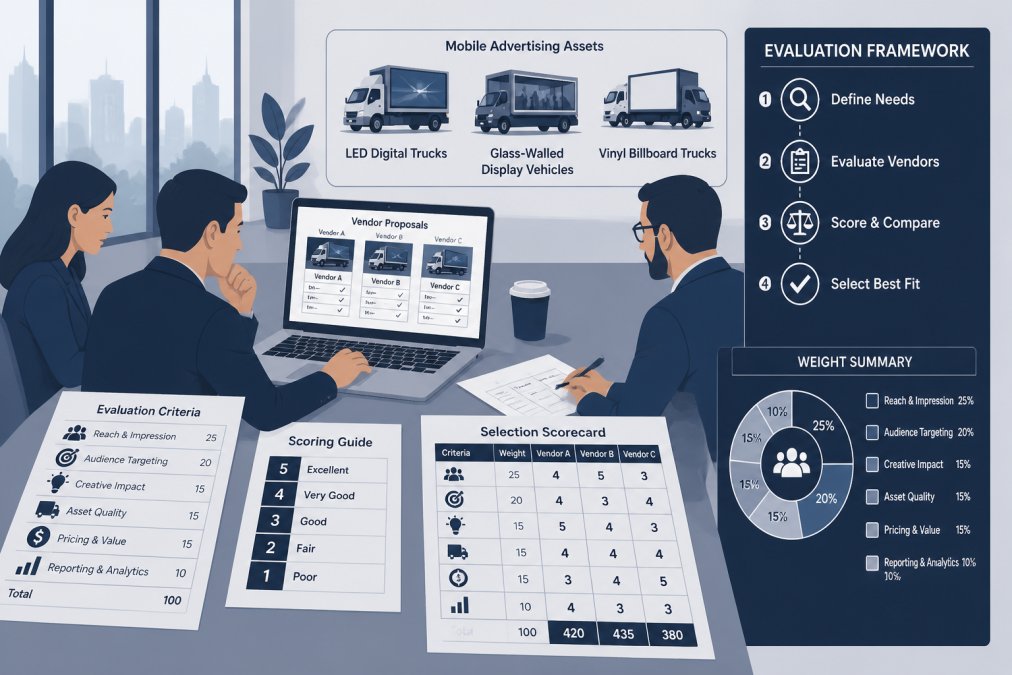
Build your scorecard around criteria that matter to your campaign:
| Evaluation Criteria | Weight | Vendor A | Vendor B | Vendor C |
|---|---|---|---|---|
| Fleet size and vehicle types | 20% | Score 1-5 | Score 1-5 | Score 1-5 |
| Industry experience | 15% | Score 1-5 | Score 1-5 | Score 1-5 |
| Campaign strategy and targeting | 20% | Score 1-5 | Score 1-5 | Score 1-5 |
| Verification and tracking capabilities | 15% | Score 1-5 | Score 1-5 | Score 1-5 |
| Client references and reviews | 15% | Score 1-5 | Score 1-5 | Score 1-5 |
| Pricing and contract terms | 15% | Score 1-5 | Score 1-5 | Score 1-5 |
Score each vendor 1 to 5 per criterion, multiply by the weight, and total. This removes bias and shows which vendor best matches your priorities.
At Texas Mobile Advertising, we recommend weighting campaign strategy and targeting heavily because vendors who understand your market and position vehicles strategically consistently deliver better results than those with more vehicles but weaker placement strategy.
Red Flags and Contract Terms to Review
Before signing, watch for warning signs.
Review contract terms carefully. Ensure the contract specifies the exact vehicles, campaign dates and times, geographic coverage, and what happens if the vendor fails to deliver.
Verify liability and insurance. Ask for proof of insurance covering vehicles and operations, and understand who’s liable if something goes wrong.
Check measurement and reporting terms: what documentation will the vendor provide, how frequently, and will they include GPS verification and photo evidence of placements?
Red flag: Vague contract language about campaign execution, deliverables, or measurement. Insist on specific, measurable commitments before signing.
Ask about exclusivity. Can the vendor run competing brands’ campaigns simultaneously in the same area? Clarify before committing.
Choosing the right mobile advertising vendor requires systematic evaluation rather than impulse decisions. At Texas Mobile Advertising, we’ve completed over 1,400 mobile billboard advertising vehicle campaigns, and we’ve learned that vendors who combine strong strategic planning with transparent measurement and verification consistently deliver the best results.
Frequently Asked Questions
What should you look for when choosing a mobile advertising vendor?
Look for vendors with proven experience in your industry, a fleet of well-maintained mobile advertising assets, transparent pricing, and strong measurement capabilities. Request case studies and client references specific to your campaign type. Ask about their approach to brand safety, ad fraud prevention, and how they handle data ownership. Verify they can scale to meet your campaign timeline and geographic needs.
How can you measure the results of a mobile billboard campaign?
Effective measurement combines multiple approaches: foot traffic tracking via location data, call tracking with unique phone numbers, QR codes on the mobile asset directing to trackable landing pages, and conversion attribution through your point-of-sale system. Ask vendors about their analytics reporting capabilities and how they handle privacy compliance. Establish baseline metrics before launch so you can isolate the mobile advertising impact from other marketing channels.
What questions should you ask a mobile advertising vendor before hiring them?
Ask about their specific experience with your industry, the condition and specifications of their fleet, how they prevent ad fraud and protect brand safety, their measurement and reporting methodology, contract terms regarding data ownership, cancellation policies, and how they handle campaign optimization. Request references from clients with similar campaign objectives. Clarify communication frequency, account support availability, and the approval process for creative assets.
How does mobile advertising cost compare to traditional advertising channels?
Mobile billboard pricing depends on campaign duration, vehicle type, geographic coverage, and local market demand. Costs typically reflect the specialization and exclusivity of the asset. Request quotes from multiple vendors to compare pricing models, some charge daily rates, others by campaign length or geographic zone. Ask about discounts for multi-week or multi-location campaigns. Compare the cost per impression and cost per acquisition against your radio or traditional billboard spend to evaluate return on investment.