
Mobile Advertising for Healthcare Clinics: 2026 Guide
Table of Contents
- Why Mobile Advertising Works for Healthcare Clinics
- Healthcare Clinic Advertising Ideas That Fill Appointment Slots
- Mobile Advertising Campaign Planning for Clinics
- Step 1: Write a measurable goal
- Step 2: Build a patient segment and service-area map
- Step 3: Choose formats and match them to the goal
- Step 4: Set routes and dayparts
- Step 5: Budget planning and cost benchmarks
- Step 6: Prepare creative before you book the truck
- Step 7: Launch, then track calls, web visits, and bookings
- Healthcare Advertising Best Practices and Compliance
- How to Measure Mobile Advertising Campaign Performance
- Frequently Asked Questions
Last Updated: October 16, 2026
Why Mobile Advertising Works for Healthcare Clinics
Mobile advertising for healthcare clinics puts your message on a moving LED screen that reaches patients where they already are. Unlike a fixed billboard people pass daily and stop seeing, a mobile billboard truck travels new routes and meets fresh eyes.
The channel works because it fits how patients choose care. Most pick a clinic close to home or work, and they decide fast.
The Limits of Radio, TV, and Static Billboards
Radio and TV ads get skipped, muted, or streamed past. Static billboards sit in one spot and reach only the traffic already using that road. Mobile advertising solves both: your clinic’s message moves through different neighborhoods on different days, so you reach more of your service area without buying multiple fixed locations.
What Mobile Billboards and LED Trucks Actually Do
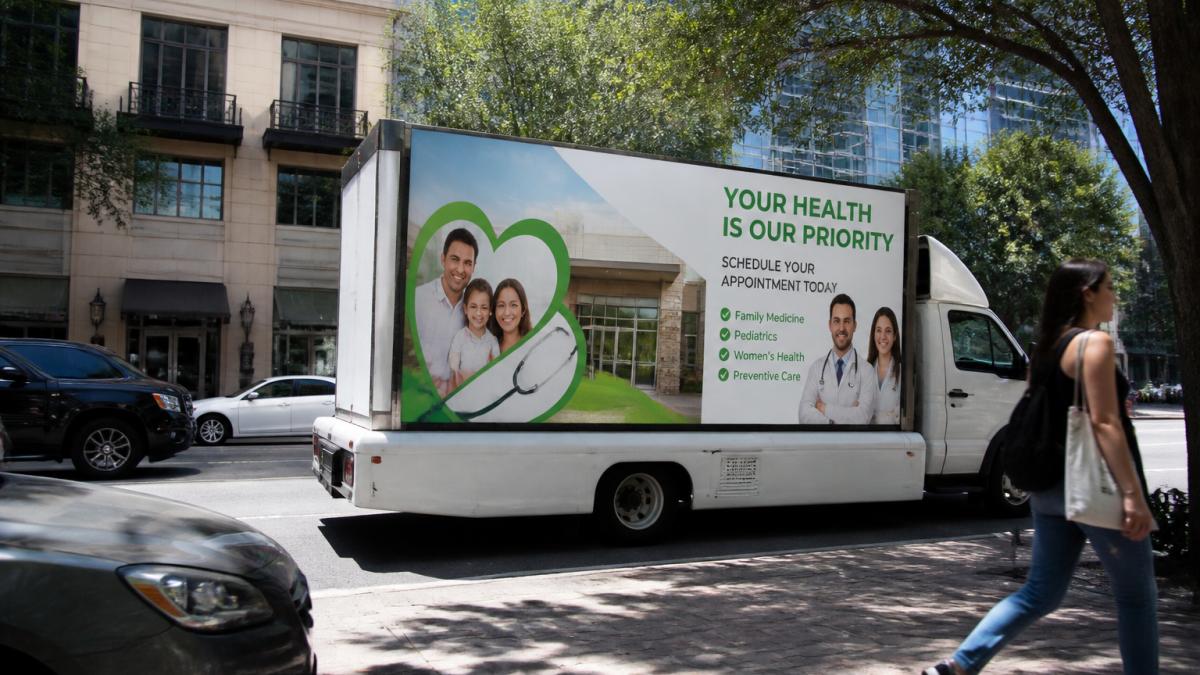
A mobile billboard is a truck-mounted display that carries your ad through targeted routes. LED digital trucks show video and images on bright onboard screens. Glass-walled display vehicles turn the truck into a moving showroom. Vinyl billboard trucks carry large-format panels for maximum visibility. Each format puts a promotional message in front of a local audience at a fraction of the reach cost of legacy media.
Healthcare Clinic Advertising Ideas That Fill Appointment Slots
The best healthcare clinic advertising ideas tie a clear service to a specific audience and time. Generic “we care about you” messaging does not fill slots. A direct offer does.
Here are formats that work for clinics:
- New location launches: Blanket the surrounding neighborhoods for two weeks before opening day.
- Seasonal campaigns: Push flu shots in fall, sports physicals in late summer, and allergy care in spring.
- Service line promotion: Feature a new imaging center, urgent care, or specialty department.
- Wait-time messaging: Advertise short ER wait times to steer patients to your emergency room.
CDC guidance on seasonal flu vaccination timing confirms that fall is when most patients act on vaccine messaging, which makes timing a real lever for clinics.
Service Line Launches and Seasonal Campaigns
A service line launch needs repetition to stick. Run your mobile campaign at least two to three weeks so residents see the ad multiple times, and pair the display with one simple call to action: a phone number, a website, or a location name they can remember.
Community Events and Health Screening Drives
Health screening drives and community events give you a built-in audience. Park a glass-walled display truck at the event, run a screening sign-up, and let the vehicle double as a landmark. This works well for hospitals, mobile medical units, and clinic marketing teams building local trust.
Most clinics underestimate route timing. A truck parked outside a hospital shift change at 7 a.m. or 7 p.m. reaches staff and visitors who are already thinking about care. Match your route to when your audience is already moving.
Mobile Advertising Campaign Planning for Clinics
Mobile advertising campaign planning for clinics comes down to four decisions: who you want to reach, where they are, when they will see you, and how you will know it worked. Get those right and the rest is execution. Most clinics that run a mobile campaign without a written workflow buy impressions instead of appointments.
Step 1: Write a measurable goal
“Increase new patient bookings at our north-side clinic by a set number this quarter” beats “raise awareness.” Tie the goal to a service line, a location, and a time window. If it cannot be counted at the front desk, it is not a goal, it is a slogan.
Step 2: Build a patient segment and service-area map
Start with your own data, not a guess. Pull the ZIP codes your front desk collects at intake and rank them by new-patient volume, then draw a 3- to 5-mile ring around the clinic. The overlap is your primary service area; everything outside it is secondary and should get a smaller share of the run.
Layer on the segments that actually book:
- New movers, households that changed address in the last 90 days, the highest-intent group for a new clinic.
- Age bands tied to the service, pediatric, sports physical, and OB patients skew young families; Medicare annual wellness visits skew 65+.
- Employer clusters, large employers, hospital shift changes, and school districts create predictable commute windows.
- Event audiences, county fairs, 5K runs, and health screening drives put your exact patient in one place for a few hours.
Step 3: Choose formats and match them to the goal
| Campaign Goal | Best Format | Typical Run Length | What to Track |
|---|---|---|---|
| New clinic launch | LED digital truck | 2-3 weeks | Web visits, calls |
| Seasonal service push | Vinyl billboard truck | 1-2 weeks | Bookings, promo codes |
| Event or screening drive | Glass-walled display vehicle | 1-3 days | Sign-ups, foot traffic |
| Ongoing brand awareness | LED digital truck | 4+ weeks | Brand searches, new patients |
Step 4: Set routes and dayparts
Routes should follow your patients, not random streets. Build loops around the clinic, nearby grocery stores, schools, and event venues, and run during daylight and commute hours. A common pattern is a morning loop through residential ZIPs, an afternoon loop past retail and medical office clusters, and a parked stop at a high-traffic intersection during lunch.
Step 5: Budget planning and cost benchmarks
Pricing depends on how many vehicles you need, how many days you run, and how far they travel, so most providers quote per project rather than posting a flat rate. A practical way to plan is to work backward from a target cost per new patient:
- Estimate the number of new patients the campaign needs to justify itself.
- Multiply by your average patient lifetime value (a primary care patient is worth far more over years than a single urgent care visit).
- Set the campaign budget at a fraction of that value, many clinics cap it at 10-20% of projected first-year revenue from the campaign.
- Ask for a quote that fits the budget, then compare cost per thousand impressions against your current radio or static billboard spend.
Step 6: Prepare creative before you book the truck
Creative that names the service, the location, and one action outperforms brand-only panels. Keep the phone number or short URL large enough to read at 35 mph. If the ad runs on an LED truck, design for motion, a static image on a moving screen wastes the format.
Step 7: Launch, then track calls, web visits, and bookings
Set up tracking before the first mile. A campaign-specific phone number, a dedicated landing page, and a promo code give you three independent signals. Review them weekly and shift routes toward the ZIPs and dayparts that convert.
Contact Us Now for a Free Consultation →
Do not run a healthcare ad without a clear next step. A moving truck with a logo but no phone number or location wastes the impressions. Every panel needs one action the viewer can take.
Healthcare Advertising Best Practices and Compliance
Healthcare advertising best practices start with privacy. HIPAA protects patient health information, and ads that hint at a person’s condition can cross the line. HHS guidance on HIPAA marketing rules explains when a clinic needs authorization before using patient data in marketing.
The FTC also watches healthcare claims. FTC guidance on health claims in advertising requires that any health benefit you state be truthful and backed by evidence. That means no exaggerated cure claims and no misleading before-and-after results.
HIPAA, FTC rules, and patient consent
Keep these rules in mind for every campaign:
- Get written consent before using any patient story or image.
- Never show a real patient’s face or condition without permission.
- Make only claims you can support with evidence.
- Avoid implying you know a viewer’s health status.
Sensitive-data targeting: what not to do
This is where mobile advertising gets clinics into trouble. You cannot build an audience based on a health condition, diagnosis, treatment, or prescription, no targeting “diabetics,” “cancer patients,” or “people researching depression.” Target geography, age band, and general interest instead, then let the creative speak to a service line without implying you know anything about the viewer.
A workable rule: if the ad would feel invasive to a patient standing next to you, do not run it.
Consent and creative review
Before any campaign launches, run the creative through a short internal review:
- Does the ad use a real patient’s image, story, or testimonial? If yes, is there signed authorization on file?
- Does any claim promise a result, a cure, or a guaranteed outcome?
- Does the ad imply the viewer has a condition?
- Are pricing, insurance, and availability statements accurate for the location being advertised?
- Is there one clear action the viewer can take?
Platform and channel rules
Mobile advertising is not one channel, and each carries its own healthcare rules. Mobile search and social platforms restrict or require certification for certain health categories, including addiction treatment, clinical trials, and some prescription services. SMS campaigns fall under the Telephone Consumer Protection Act (TCPA), which requires prior express written consent for marketing texts and an easy opt-out in every message.
A simple compliance checklist
- Written patient authorization on file for any identifiable patient content.
- No condition-based audience targeting.
- Every health claim substantiated and reviewed by clinical or legal staff.
- TCPA-compliant consent and opt-out for any SMS component.
Clinics that follow these steps protect themselves and build patient trust at the same time.
Compliance is not a launch-day checkbox. Build the review into creative development so you are not rewriting a truck wrap the week the campaign is supposed to start.
How to Measure Mobile Advertising Campaign Performance
Measurement is where most clinics fall short, and it is the fastest way to prove the channel works.
Build a simple measurement framework:
- Unique phone number: Use a campaign-specific number to count calls.
- Landing page: Send viewers to a page built just for the campaign.
- Promo code: Offer a code patients mention at booking.
- Location questions: Ask new patients how they heard about you.
Track these against your baseline before the campaign.
The clinics that get the most from mobile advertising are the ones that plan measurement before launch. Pick your tracking method first, then build the campaign around it.
Texas Mobile Advertising runs campaigns like this for healthcare systems and clinics across the region. Our fleet of LED digital trucks, glass-walled display vehicles, and vinyl billboard trucks turns your service promotion into a moving experience people actually notice, and we can scale to multiple locations at once.
Getting patients to notice your clinic in a crowded market is the hard part. Radio gets skipped and static billboards get tuned out, but a moving LED display is hard to ignore.
Frequently Asked Questions
How can a clinic use mobile billboards to reach potential patients?
Clinics can route mobile billboards through high-traffic areas near their locations, around community events, and along commuter corridors. Unlike static billboards, mobile advertising lets you target specific neighborhoods, adjust routes by time of day, and display rotating messages for different services. This flexibility helps clinics reach local audiences where they already are, rather than waiting for them to pass a fixed location.
What should a healthcare clinic include in a mobile billboard ad?
Keep the message simple and focused on one service or call to action. Include your clinic name, a clear benefit (such as same-day appointments or extended hours), and a phone number or website. Avoid medical jargon and complex imagery. Large, readable text and high-contrast colors work best. If you are promoting a specific service line, feature that prominently rather than listing everything you offer.
What advertising rules should healthcare clinics consider?
Healthcare advertising must comply with FTC truth-in-advertising rules, which prohibit deceptive claims about treatments or outcomes. HIPAA privacy rules apply if you use patient testimonials or images, so you need written consent. Some states also regulate medical advertising content. Work with your compliance team to review all creative before it goes on a truck, and avoid guarantees of results or before-and-after claims that could mislead.
How can clinics measure the results of mobile advertising?
Use a dedicated phone number or landing page for the campaign so you can track calls and web visits. Ask new patients how they heard about you at intake. If your clinic uses appointment scheduling software, add a campaign-specific booking link. Compare patient volume and call volume during the campaign period against your baseline. Mobile advertising works best as part of a mix, so look at overall trends rather than isolating one channel.