
Best Ways to Drive Local Store Traffic in 2026
Table of Contents
- Why Local Store Traffic Is Harder to Earn in 2026
- How to Increase Foot Traffic to a Retail Store With Mobile Billboards
- Outdoor Advertising for Local Businesses: Matching the Format to the Goal
- Local Store Marketing Ideas That Compound Over Time
- In-Store Event Ideas for Retailers That Pull a Crowd
- Training Staff to Convert the Traffic You Paid For
- How to Measure Whether Your Campaign Actually Increased Store Traffic
- Conclusion: Pick Two Tactics and Commit for 90 Days
- Frequently Asked Questions
Last Updated: October 13, 2026
Why Local Store Traffic Is Harder to Earn in 2026
Local store traffic is the number of people who walk through your doors during a given period, and it has become harder to earn than at any point in the past decade.
The problem is not demand. Below, we break down the best ways to drive local store traffic in 2026, from mobile billboards to in-store events to the retention tactics most guides skip.
How to Increase Foot Traffic to a Retail Store With Mobile Billboards
The fastest way to increase foot traffic to a retail store is to put your message in front of people who are already nearby and already moving.
What Mobile Billboards Do That Static Signs Cannot
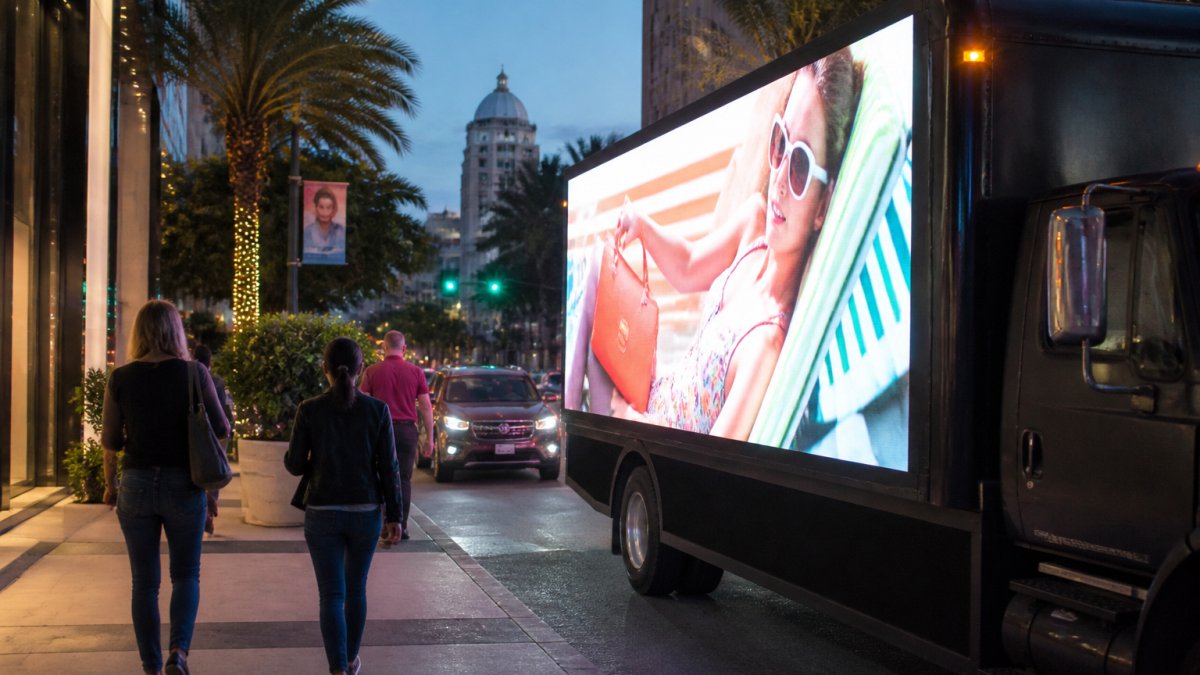
Static signs wait for traffic. Mobile billboards follow it. A fixed highway billboard may reach thousands of commuters who never come within a mile of your store, while a mobile unit can be routed through the neighborhoods, retail corridors, and event zones where your buyers actually spend time.
Three things set mobile formats apart:
- Movement creates attention. A moving, brightly lit object interrupts the visual routine of a street in a way a stationary panel does not.
- Video and image ads run on board. LED digital trucks display full-motion content, so you can show a product, a limited-time offer, or an event countdown.
- Vehicles become showrooms. Glass-walled display trucks let you put the product itself on the street, which turns a passing glance into a reason to stop.
For retailers tired of paying for impressions that never convert, mobile advertising puts the message where the decision happens.
Outdoor Advertising for Local Businesses: Matching the Format to the Goal
Outdoor advertising for local businesses works best when the format matches the objective. A grand-opening push needs different assets than a slow-weekday traffic fix.
| Goal | Best Format | Why It Fits |
|---|---|---|
| New store launch | LED digital truck | High-visibility motion and video for a short, intense window |
| Everyday foot traffic | Vinyl billboard truck | Broad, cost-efficient coverage across routine routes |
| Product sampling or demo | Glass-walled display vehicle | Lets shoppers see and touch the product |
| Event or festival promotion | LED truck with countdown content | Builds urgency in the days before the event |
Route Planning and Timing That Puts Ads Where Shoppers Already Are
A mobile campaign lives or dies on its route. The common mistake is treating the truck like a billboard that wanders aimlessly.
Timing matters just as much. A route at 2 p.m. on a Tuesday reaches a very different audience than one at 6 p.m. on a Friday. We plan routes around when your customer segments are already out, then repeat them across multiple days so the message compounds instead of flashing once.
Local Store Marketing Ideas That Compound Over Time
Local store marketing ideas deliver their real value when they reinforce each other instead of running as isolated one-offs. A single promotion fades in a week; a system of connected tactics keeps working for months. Most guides stop at the tactic list, so this section focuses on the two things they skip: how to tier these tactics by budget and how to turn a one-time visitor into a repeat regular.
The Three Tactics That Compound
- Loyalty programs give shoppers a reason to return, and returning customers spend more over time than first-time visitors. Make the signup part of the transaction, not a separate ask, a phone number at checkout, a QR code on the receipt, or a punch card handed over with the bag.
- Buy-online-pick-up-in-store (BOPIS) turns an online order into a store visit, and many pickup customers buy something extra. Place the pickup counter deep in the store, not at the front door, so customers walk past product on the way in and out.
- Local SEO and Google Business Profile optimization make sure your store appears with accurate hours, photos, and directions when someone searches for what you sell. Post weekly updates, respond to reviews, and keep product categories current, the profile is a living asset, not a one-time setup.
The connection point is data. Every loyalty signup, BOPIS pickup, and profile click tells you which segments respond to which message. Use that to decide where the mobile billboard runs next.
Budget Tiers: What to Run With $0, $500, and $5,000
Generic advice fails small business owners because it ignores budget. Here is how the same tactics scale:
- Zero-cost: claim and optimize your Google Business Profile, ask satisfied customers for reviews, start a punch-card or phone-number loyalty list, enable BOPIS on your existing website or POS, and post events to local community groups.
- Low-cost (a few hundred dollars): a small mobile billboard run on your highest-traffic days, a paid micro-influencer post, printed bounce-back cards, and a modest SMS or email tool for follow-up.
- Higher-investment: a multi-week mobile billboard campaign routed through customer neighborhoods, a full loyalty program with POS integration, paid local search ads, and a part-time marketer to run retention.
Start at the tier you can sustain for 90 days. A tactic you abandon after two weeks does not compound, it just costs money.
Post-Visit Retention: The Step Most Guides Skip
Driving traffic is only half the job. Retailers who grow turn a first visit into a second, third, and tenth. A simple retention loop:
- Capture contact info at the point of sale, phone number for SMS, email for receipts, or a loyalty signup. Ask once, make it easy, explain the benefit.
- Send a thank-you within 24-48 hours with a reason to return: a bounce-back offer, a preview of next week’s arrival, or an event invitation.
- Trigger a win-back message if a customer has not visited in 60-90 days. A short “we miss you” text with a small incentive recovers a surprising share of lapsed customers.
- Reward frequency, not just spend. A free item after five visits often drives more repeat trips than a percentage-off discount because it gives a concrete goal.
Measure the Loop, Not Just the Visit
Track repeat visit rate alongside door count. If door count rises but repeat rate is flat, you are renting traffic instead of building it. The fix is usually in the follow-up: capture more contact info, send the thank-you faster, or make the return incentive more specific.
Tie your mobile billboard route to your BOPIS pickup windows. Running the truck through a neighborhood in the hour before pickup traffic peaks reminds nearby customers that their order is waiting, and it nudges the ones who have not ordered yet.
Compounding tactics share one trait: each one feeds data or customers into the next. Loyalty feeds your contact list, BOPIS feeds store visits, local SEO feeds discovery, and retention feeds all three. Pick the tier you can sustain, then connect the pieces.
In-Store Event Ideas for Retailers That Pull a Crowd
In-store event ideas for retailers work when they give people a specific reason to show up on a specific day. “Come visit us” is not a reason; “Meet the maker Saturday at 11” is. An event that fills the room usually has three things: a clear hook, a promotion plan that reaches people who have never been inside, and a follow-up that turns attendees into regulars.
Event Formats That Consistently Draw
- Workshops and how-to sessions tied to what you sell, cooking demos, repair clinics, styling sessions, plant-care classes. Charge a small fee or require a reservation; a nominal commitment dramatically reduces no-shows versus a free event.
- Local maker and vendor pop-ups that bring their own audiences through your door. The vendor promotes to their list, you provide the space, and both sides gain new customers.
- Seasonal or holiday-themed nights with a tight window (say, 6-8 p.m.) and a small giveaway. A defined window creates urgency an all-day event never does.
The Promotion Plan Is What Fills the Room
The mistake most retailers make is promoting the event only inside the store, to people who already know them. Promote outward, starting at least two weeks out:
Contact Us Now for a Free Consultation →
- Google Business Profile event post, free, indexed, and shows up when locals search for things to do.
- Local micro-influencers, one neighborhood creator with 5,000 engaged followers often outperforms a paid ad for event RSVPs.
- Mobile billboard route in the week before, through the neighborhoods your target attendees live in.
Budget Tiers: What an Event Actually Costs
Event costs swing wildly, so plan by tier:
- Zero-cost: a vendor pop-up where the vendor promotes to their own audience, a book club or run club meetup, a Google Business Profile event post, and an in-store demo using product you already stock.
- Low-cost: a paid micro-influencer post, printed flyers, a small giveaway, and a modest mobile billboard run on the day of the event.
- Higher-investment: a full mobile billboard campaign in the two weeks before the event, paid local media, a rented tent or staging, and staffing for a larger crowd.
Match the tier to the goal. A first event should be zero- or low-cost so you can learn what your audience responds to before you spend.
Turn Attendees Into Regulars
The event is not the win, the return visit is. Capture contact info at the door (a sign-in sheet or QR code to your loyalty program), hand every attendee a reason to return within 30 days (a bounce-back offer, a loyalty signup bonus, or an invitation to the next event), and follow up within 48 hours. Retailers who skip the follow-up lose most of the goodwill the event created.
Schedule your next event before the current one ends. Announcing the date while attendees are still in the room converts their enthusiasm into a calendar commitment, and gives you a second reason to reach out to them.
Training Staff to Convert the Traffic You Paid For
Staff training decides whether paid traffic becomes revenue or just a busy afternoon. You can route a thousand people past your door and still lose the sale if the person behind the counter is not ready.
What to train for:
- A consistent greeting within the first few seconds of a customer entering
- One open question that starts a conversation instead of a yes-or-no exchange
- Knowledge of the current promotion, so staff can connect the ad the customer saw to what is on the shelf
A common mistake is training staff once at hire and never again. Retail conversion improves when the team rehearses the current campaign before launch, not after.
How to Measure Whether Your Campaign Actually Increased Store Traffic
Measuring store traffic is the part most campaigns skip, which is why so many retailers cannot tell whether their spending worked. Set your baseline before the campaign starts.
Track these four numbers:
- Door count, total entries per day, measured with a door counter or a manual tally during peak hours
- Redemption rate, how many customers mention or redeem the specific offer from the campaign
- Average transaction value, so you can see whether new visitors spend like existing ones
- Cost per visit, total campaign spend divided by the increase in door count over the baseline
Compare the campaign window against the same days in prior weeks, not a random month. Weather, paydays, and local events all move traffic, so a same-day-of-week comparison gives a cleaner read. If you cannot trace a lift in door count, the campaign needs a new route, a new message, or both.
Do not judge a mobile campaign on a single day of door counts. Traffic naturally swings with weather and pay cycles, so a one-day dip tells you nothing. Run for at least two weeks and compare like days before you decide anything.
Conclusion: Pick Two Tactics and Commit for 90 Days
The retailers who grow foot traffic are not the ones who try everything at once.
Texas Mobile Advertising builds campaigns around LED digital trucks, glass-walled display vehicles, and vinyl billboard trucks, and we handle route planning so your message lands where your customers already are.
Contact us now for a free consultation and find out which two tactics will move your store traffic first.
Frequently Asked Questions
How do you measure whether a campaign increased store traffic?
Track three numbers before and after: point-of-sale transaction counts by hour, door counter data if you have it, and a simple promo code or mention question at checkout. Give each channel its own code so you can tie redemptions back to the source. Mobile billboard campaigns can use a dedicated landing page or QR code, while in-store events are measured by RSVP lists and same-day sales. Compare the same week last year to filter out seasonal noise.
What are the most effective ways to attract customers to a local store?
The tactics that consistently move the needle are mobile billboard advertising, in-store events with a clear draw, and a loyalty program that rewards repeat visits. Pair those with a complete Google Business Profile and localized SEO so people searching nearby find you first. Mobile billboards work well because they reach shoppers during their commute or lunch break, when they are already out and deciding where to stop. Layer two or three of these rather than betting on one.
How can outdoor advertising help bring customers into a store?
Outdoor advertising builds awareness in the exact neighborhoods you serve, which shortens the distance between seeing an ad and walking in. A mobile billboard driving a three-mile radius around your store hits the same people repeatedly over a week, and repetition is what turns a name into a destination. Static billboards work for broad awareness; mobile units work better for time-sensitive offers because you can route them past competitor locations or event venues on specific days.
How can local events increase foot traffic to a store?
Events give people a reason to visit that is not just shopping, which lowers the barrier to walking in. A workshop, a product demo, or a partnership with a nearby business draws a crowd that would not have stopped otherwise. Promote the event with mobile billboards in the surrounding area during the week before, and collect contact information at the door. The follow-up email or text within 48 hours is what converts a one-time visitor into a repeat customer.