
Benefits of Mobile LED Billboards for Local Marketing
Table of Contents
- Why Mobile LED Billboards Stand Out From Static Advertising
- High Visibility and Attention Capture With Digital Displays
- Geographic Targeting and Route Flexibility for Local Campaigns
- Mobile Billboard Advertising Examples That Drive Results
- Mobile Billboard Campaign Strategy for Maximum Impact
- Mobile Billboard Advertising Cost and Return on Investment
- When Mobile LED Billboards Deliver Real Business Impact
- Frequently Asked Questions
Last Updated: October 18, 2026
Why Mobile LED Billboards Stand Out From Static Advertising
Static billboards sit in one location, display one message, and hope the right audience drives past. Mobile LED billboards change that equation entirely.
The core difference is movement. A mobile LED billboard travels to your audience instead of waiting for them to come to you. Unlike traditional billboards that blend into the urban landscape, digital displays on moving vehicles command attention because they’re unexpected and dynamic.
At Texas Mobile Advertising, we’ve worked with over 1,400 completed mobile billboard campaigns. What we’ve learned is simple: static advertising gets ignored. Mobile LED billboards break through that noise because they’re active, present, and impossible to dismiss as background clutter.
The flexibility matters too. You can adjust your message in real time, responding to local events, weather, or competitive activity without waiting weeks for a design and installation cycle. Your advertisement evolves with your campaign needs.
The best time to deploy a mobile LED billboard is when your static advertising is performing well but you need to break through to a new segment. The mobile element reaches people in different contexts and moments than a fixed location ever could.
High Visibility and Attention Capture With Digital Displays
The human brain processes moving images faster than static ones (The interaction of speed and time in biasing the perception of dynamically changing…). When a vehicle with a bright LED screen drives through traffic, it registers immediately.
Digital displays on mobile billboards deliver what static advertising cannot: brightness, motion, and dynamic content. An LED screen can display video, animate text, or cycle through multiple messages, and the illumination is visible in daylight, at night, and in most weather conditions.
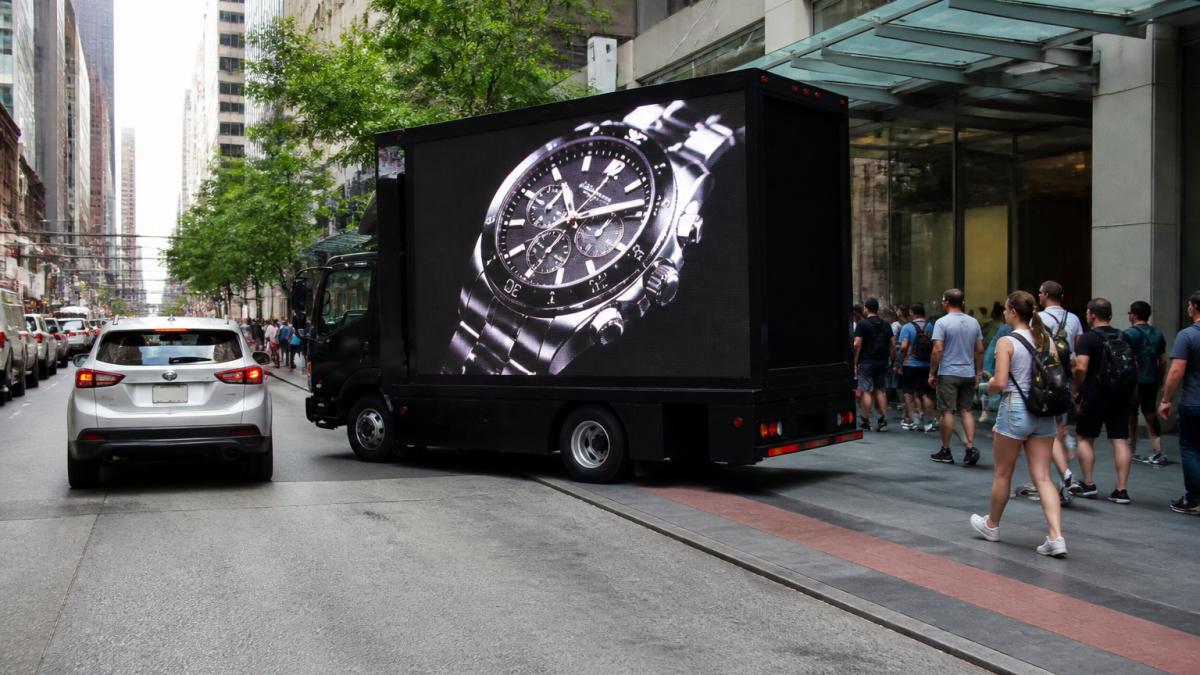
The attention capture happens in seconds. When people see movement in their peripheral vision, they look, and a bright screen with changing content holds them longer than a static image. This creates what researchers call “dwell time.”
For local marketing, this matters enormously. A restaurant launching a new location needs foot traffic now, not passive brand awareness. A healthcare system promoting a new clinic needs people to know it exists and where to find it. Mobile LED billboards create that immediate awareness through visibility and motion.
Digital displays capture attention 3-5 times longer than static billboards because motion and brightness override the brain’s tendency to filter out background advertising.
Geographic Targeting and Route Flexibility for Local Campaigns
This is where mobile billboard advertising becomes a precision tool. You’re not paying to reach everyone across a region, you’re paying to reach your target audience in specific locations at specific times.
Route planning is the strategy behind geographic targeting. Your mobile billboard follows a planned path through neighborhoods where your audience lives, works, or shops. A healthcare system opening a new clinic can route the truck through surrounding residential areas during commute times; a restaurant group can position the vehicle near competitor locations and high-traffic shopping districts.
The flexibility changes how campaigns work. Static advertising locks you into a location; mobile advertising lets you adjust based on performance. If one route generates more foot traffic than expected, you can increase frequency there. If another area isn’t converting, you shift resources elsewhere.
Local events create opportunities that static advertising can’t exploit. A music festival, sports event, or community gathering draws a concentrated audience, and a mobile LED billboard positioned near the event reaches that exact audience at the moment they’re most receptive.
Geographic targeting also means cost efficiency. You’re not paying for impressions in areas where your customers don’t live or work, and for regional chains and local businesses, this precision matters more than broad reach.
Mobile Billboard Advertising Examples That Drive Results
Real-world applications show how mobile LED billboards solve specific business problems.
A healthcare system opening three new clinic locations faced a common challenge: awareness. It deployed mobile LED billboards in neighborhoods surrounding each location, rotating messages about services, hours, and directions. Foot traffic to the new clinics exceeded projections in the first month.
A restaurant group launching a new location used mobile billboard advertising to build pre-opening buzz. The truck displayed the opening date, menu highlights, and special promotions near competitor locations and high-traffic shopping areas. Opening day saw lines out the door.
An event coordinator promoting a large music festival used mobile LED billboards across multiple neighborhoods. The dynamic display rotated through artist lineups, ticket prices, and event details, and the coordinator adjusted messaging based on ticket sales velocity, featuring artists with the strongest presale numbers.
A retail chain opening a new store deployed the mobile billboard through surrounding residential neighborhoods and near major shopping competitors. The campaign ran three weeks before opening day and two weeks after, creating local awareness that paid off in foot traffic and opening week sales.
These examples share a common thread: they use mobile billboard advertising to reach a specific audience in a specific location at a specific time, with a message tailored to that audience’s context.
A common mistake is treating a mobile billboard like a traditional billboard, creating one static message and expecting it to work everywhere. Mobile campaigns perform best when you adjust the message based on location, time of day, and audience context.
Mobile Billboard Campaign Strategy for Maximum Impact
Effective mobile billboard campaigns require intentional strategy, not just driving around with a bright screen.
Start with your objective. Are you building awareness for a new location, driving foot traffic to an event, or promoting a limited-time offer? Your objective determines your route, message, frequency, and timing.
Route selection comes next. Map the neighborhoods where your target audience lives and works, identify high-traffic areas where they spend time, and consider competitor locations, shopping districts, and community gathering spots. Your route should concentrate exposure where your audience can see the message and act on it.
Message strategy matters more with mobile billboards than static ones. You can display video, animate text, and cycle through multiple messages, so test different creative approaches. A message that works for one audience segment might not resonate with another.
Contact Us Now for a Free Consultation →
Timing affects performance. Morning commute times reach people heading to work, lunch hours concentrate audience in business districts, and weekends change traffic patterns entirely. A campaign that runs only during evening commute times will perform differently than one running across all daylight hours.
Frequency builds recall. A single pass through a neighborhood creates minimal impact; multiple passes across days and weeks build familiarity. Most effective campaigns run at least two weeks, with the mobile billboard appearing multiple times in target areas.
Duration matters too. A two-week campaign builds awareness, a four-week campaign drives action, and a six-week campaign creates sustained visibility that translates to behavior change. The longer your campaign, the more likely people are to remember your message and act.
Mobile Billboard Advertising Cost and Return on Investment
Understanding the investment in mobile billboard advertising means knowing what you’re paying for and what results to expect.
Pricing for mobile billboard advertising depends on several factors: the type of vehicle and display, the duration of the campaign, the geographic area, and the frequency of routes through target neighborhoods. A short campaign in a limited area costs less than a long campaign covering multiple regions.
What matters more than the absolute cost is the return on that investment. Mobile billboard advertising delivers results when it reaches the right audience with the right message at the right time. A healthcare system opening a new clinic might invest in a two-week campaign and see patient volume exceed projections.
The key to ROI is measurement. Track what you can measure: foot traffic to your location, phone inquiries, website visits, or sales during the campaign period. Compare these metrics to baseline periods before the campaign started. Compare them to results from comparable locations or time periods.
One advantage of mobile billboard advertising over traditional media is the ability to adjust spending based on early results. If the first week of a campaign shows strong response, you can extend it or increase frequency. If results are weaker than expected, you can modify the message or route.
The ROI calculation depends on your business model. Each business calculates differently, but the principle is the same: measure the incremental results generated by the mobile billboard campaign and compare to the cost.
When Mobile LED Billboards Deliver Real Business Impact
Mobile LED billboards aren’t the right solution for every marketing challenge. Knowing when they work is crucial to making smart advertising decisions.
They work best when you have a specific geographic area you want to reach. If your audience is concentrated in particular neighborhoods, a mobile billboard can deliver high-frequency exposure to that exact area.
They work when you need to build awareness quickly. A new location opening in two weeks needs immediate visibility. A limited-time promotion needs to reach people before the offer expires. A special event needs attendance.
They work when your message is simple and visual. A billboard, mobile or static, has seconds to communicate. Complex messages don’t work. Simple, visually compelling messages that communicate instantly are ideal.
They work when you can measure results. The best mobile billboard campaigns are those where you can track whether they’re actually driving behavior.
They work less well when your brand is already well-established and you’re trying to drive subtle preference shifts. Mobile billboards create awareness and urgency.
They work less well in markets where your audience doesn’t drive.
They work when combined with other marketing efforts. A mobile billboard campaign paired with digital advertising, email marketing, or in-store promotions creates reinforcement. People see the mobile billboard, then see your message again online or in-store.
Mobile LED billboards represent a different approach to advertising, one where your message moves to your audience instead of waiting for them to find you. For businesses launching new locations, promoting time-sensitive offers, or building rapid local awareness, mobile billboard advertising delivers impact that traditional static advertising cannot match.
When you’re ready to explore how mobile LED billboards can drive results for your business, Texas Mobile Advertising offers a free consultation to assess your specific needs and develop a campaign strategy tailored to your objectives.
| Campaign Type | Best Use Case | Typical Duration | Key Success Factor |
|---|---|---|---|
| New Location Launch | Retail, restaurant, healthcare clinic opening | 2-4 weeks | Geographic targeting around new location |
| Event Promotion | Music festival, sports event, community gathering | 2-3 weeks before event | High-traffic areas near event venue |
| Limited-Time Offer | Flash sale, seasonal promotion, special pricing | 1-2 weeks | Simple, urgent messaging |
| Brand Awareness | New market entry, rebranding, market expansion | 4-6 weeks | Repeated exposure in target neighborhoods |
| Competitive Positioning | Launching near competitor, capturing market share | 3-4 weeks | Strategic routing near competitor locations |
Frequently Asked Questions
How do mobile LED billboards compare to traditional static billboards?
Mobile LED billboards deliver dynamic, changing content that captures attention far more effectively than static displays. While traditional billboards show one fixed message, LED digital trucks display multiple messages, videos, and images that adapt to time of day, location, and audience. This flexibility means your message stays fresh and relevant, and the illumination ensures visibility day and night. Static billboards cannot match the engagement or message recall that motion and bright displays generate.
Can mobile LED billboards target specific neighborhoods or events?
Yes. Mobile LED billboards offer complete route control, allowing you to target specific neighborhoods, shopping districts, event venues, or competitor locations. You choose where the truck travels and when, so you can concentrate advertising spend in high-traffic areas where your target audience is present. This geographic flexibility is impossible with fixed billboards and makes mobile LED trucks ideal for event promotion, local business launches, and neighborhood-specific campaigns.
How do you measure the results of a mobile LED billboard campaign?
Measurement methods include foot-traffic tracking at store locations during campaign periods, coupon code redemption specific to the campaign, QR codes on the display linking to landing pages, phone call tracking with unique numbers advertised on the truck, and GPS data showing where the vehicle traveled. Unlike traditional billboards, mobile LED campaigns allow you to correlate vehicle routes with sales spikes at nearby locations, providing concrete data on campaign effectiveness and ROI.
Is mobile billboard advertising suitable for healthcare and professional services?
Absolutely. Healthcare systems, urgent care clinics, dental practices, and professional service providers use mobile LED billboards to build local brand awareness and drive patient or client acquisition. The high-visibility format works particularly well for clinic location launches, new service announcements, and community health events. The ability to target specific neighborhoods means you reach patients in your service area without wasting budget on distant locations.