
Are Digital Billboard Trucks Worth It for Your Campaign?
Last Updated: November 15, 2026
Quick Summary
Digital billboard trucks are worth it when a campaign has a local focus, a defined time window, and a message that benefits from motion or frequent updates. Their value depends on route, audience and how well results can be measured, not on the day rate alone. The best comparison uses cost per thousand impressions.
- Compare campaigns by CPM, total cost divided by estimated impressions, multiplied by 1,000.
- A low day rate can cost more per impression if production, permits or reporting are excluded.
- Capture a baseline for two to four weeks before launch to measure lift.
- Use unique promo codes, tracked landing pages or call numbers to attribute response.
- The format fits local launches and events, and may not suit national reach campaigns.
Table of Contents
- What Digital Billboard Trucks Are and How They Work
- Digital Versus Static Mobile Billboards
- Digital Billboard Truck Cost and What Drives Pricing
- Pros and Cons of Digital Billboard Trucks
- Mobile Billboard Advertising Effectiveness: Attention, Routes and Audience Exposure
- Calculating Mobile Billboard Advertising ROI and How to Measure Results
- Deciding Whether a Digital Billboard Truck Fits Your Campaign
- Frequently Asked Questions
Are digital billboard trucks worth it for a campaign that needs to reach people in Texas, and at what cost? This guide explains where the format earns its budget and where it does not. The short answer depends on your goal, your audience and how you measure results, so the sections below walk through each factor in turn.
Digital billboard trucks are a form of out-of-home advertising. They are vehicles fitted with LED screens that display video and images while moving or parked in high-traffic spots. Because the message travels to the audience rather than waiting for the audience to pass a fixed sign, the format suits launches, events and local promotions where timing and location matter.
What Digital Billboard Trucks Are and How They Work
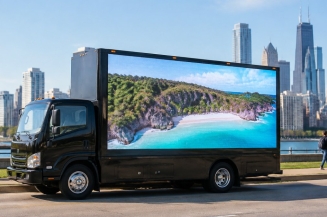
A digital billboard truck is a box truck or trailer with a large LED display mounted on one or more sides. The screen plays looping ads, so one vehicle can rotate several creatives during a single day. Some operators also use glass-walled display vehicles or vinyl billboard trucks, which are printed panels rather than screens.
Campaigns typically follow a route or park at chosen locations for set periods. A common approach is to plan routes around the times and places where the target audience is most likely to be present, such as commuter corridors, event venues or shopping districts.
Digital Versus Static Mobile Billboards
A static mobile billboard shows one printed message. A digital version can change its message, which matters when a campaign has more than one offer, a seasonal promotion or several locations that need different creative. Digital screens also support motion and video, which many advertisers use to draw attention.
The tradeoff is cost and upkeep. Digital units need power, screen maintenance and more careful content management. Printed panels are simpler and often less expensive per day, but they cannot change once the vehicle is on the road. For a single message running for a fixed period, static may be enough. For multiple creatives, time-of-day messaging or frequent updates, digital is usually the better fit.
Digital Billboard Truck Cost and What Drives Pricing
Daily rates alone are a poor basis for deciding whether a campaign is worth it, because the audience a route reaches matters as much as the rate.
The formula is simple: total campaign cost divided by estimated impressions, multiplied by 1,000. If a three-day campaign costs $4,500 all-in and the route and event plan is estimated to generate 150,000 exposures, the CPM is $30.
What goes into the total cost:
- Vehicle time. The day rate or multi-day package, which typically covers the driver, fuel, and the screen.
- Creative production. A looping video or animated ad usually needs to be built or adapted for the screen’s aspect ratio and viewing distance. Static print panels are cheaper to produce but cannot be rotated.
- Permits and parking. Event parking, street-use permits, and reserved spaces at venues can be billed separately or folded into the rate. Ask which.
- Route complexity and travel. Multi-market campaigns and long deadhead drives between stops add cost that a single-market quote will not show.
- Reporting. Route logs, play logs, and impression estimates may be included or sold as an add-on. If measurement matters to you, confirm it is in the quote before you compare rates.
A worked comparison helps. The CPM tells you the efficiency of a campaign, and the campaign goal tells you whether efficiency or timing matters more. Compare the total cost and estimated exposures of each option before choosing.
Watch out: a low day rate that excludes creative production, permits, or reporting can end up costing more per impression than a higher all-in rate, so always normalize quotes to a total campaign cost before comparing them.
To get a real number for your campaign, ask for a quote that states the total cost, the estimated impressions, and the assumed CPM. Ask the provider to build that estimate around your route, market, and campaign length so you can compare it directly against other channels.
Pros and Cons of Digital Billboard Trucks
The main advantage is that the message reaches people where they are. A truck parked outside an event or driving a commuter route puts the ad in front of people who may not see a fixed billboard or a radio spot. Digital screens add motion and the ability to rotate several ads, which helps a campaign hold attention across a day.
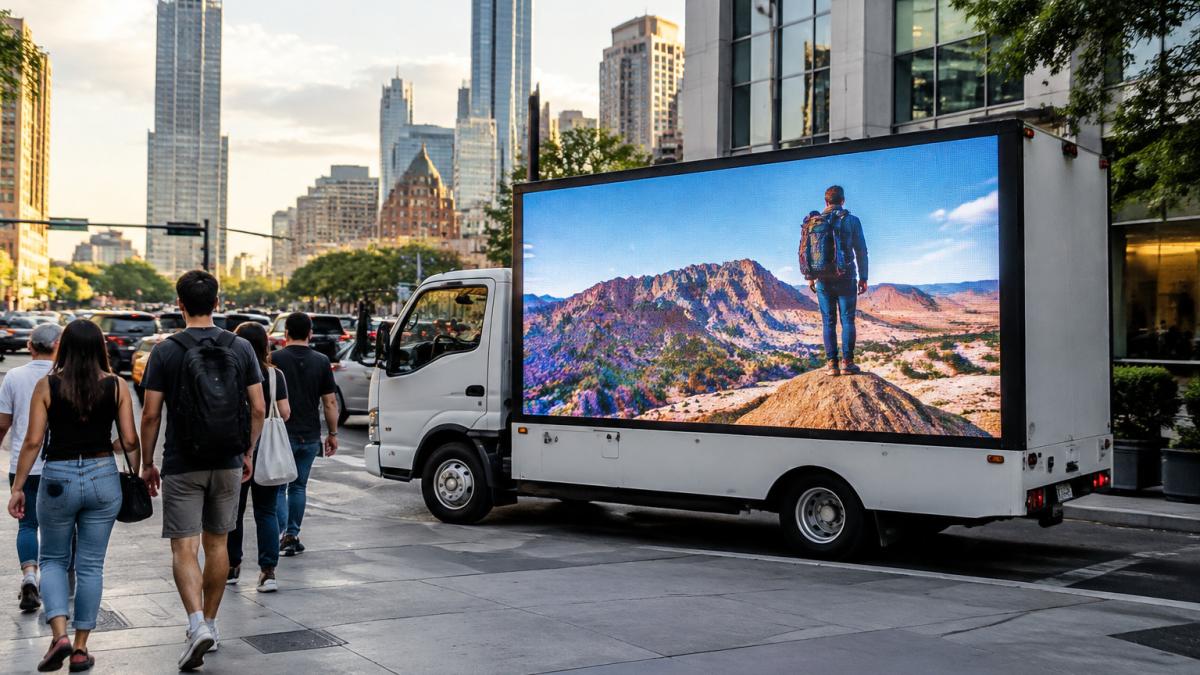
The format also has limits. Audience reach depends heavily on route and timing, so a poorly planned campaign can waste budget on empty streets. Screen brightness can be hard to judge in direct sun, and weather or traffic rules can disrupt schedules. Measurement is less direct than a digital ad with click tracking, which is discussed below.
Where it works best: launches with a local focus, festivals and sports events, new store openings and promotions aimed at a defined area.
Where it may not fit: national campaigns that need broad reach at a low cost per person, or messages that rely on click-through tracking.
Mobile Billboard Advertising Effectiveness: Attention, Routes and Audience Exposure
Effectiveness starts with exposure. A truck that drives past thousands of people in a dense area can deliver more impressions than a parked vehicle on a quiet street, but raw impression counts overstate value if the audience does not match your customers. Route quality matters as much as the screen itself.
Attention is harder to measure. Some people notice the truck and some do not, and the format competes with phones, conversations and traffic. Motion, large type and a clear single message help. Short creative that makes one point usually performs better than a dense layout, and a clear call to action, such as a web address or a store name, gives people a next step.
Attention also varies by setting. A truck at a stadium parking lot reaches a different crowd than one on a commuter highway, so match the location to the people you want to reach.
Calculating Mobile Billboard Advertising ROI and How to Measure Results
Most mobile billboard coverage stops at “use a promo code.” That is not a measurement plan, it is one tactic.
Step 1: Capture the baseline. For two to four weeks before launch, record the metrics you plan to move: website sessions, branded search volume, store visit counts if you have them, call volume, and promo-code redemptions. Without a pre-campaign baseline, any lift you see afterward is a guess. A common pattern is to compare the campaign weeks against the same number of weeks immediately prior, and against the same weeks a year earlier if seasonality is a factor.
Step 2: Choose attribution mechanisms that fit the format. Because the audience sees the ad in the physical world, attribution has to bridge to a digital or in-person action. Common options include:
- Dedicated landing pages or vanity URLs per route or market, so web traffic can be traced to a specific truck placement.
- Unique promo codes per location or daypart, redeemed online or in store.
- Call tracking numbers for location-based promotions, which capture phone response that a web form misses.
- QR codes on the creative that resolve to a tracked landing page. Keep the code large and the destination mobile-friendly; a code that requires squinting from a moving vehicle will underperform and distort your read.
- Location-based lift using store visit data or foot-traffic panels, comparing visits in the route’s trade area during the campaign against the baseline.
Step 3: Report against a defined window. Pull results weekly during the campaign and for two to four weeks after, because response to out-of-home often lags the exposure. Report the campaign window separately from the baseline period, and note any confounders, a concurrent sale, a holiday, a competitor’s launch, that could explain part of the change.
Step 4: Convert lift to dollars. If the campaign cost $6,000 and drove an estimated 400 incremental redemptions at a $40 average margin, that is $16,000 in gross margin against the spend, a clear positive.
A simple reporting table keeps the comparison honest:
| Metric | Baseline (4 weeks prior) | Campaign window | Post-campaign (2 weeks) |
|---|---|---|---|
| Website sessions | 12,400 | 15,100 | 13,200 |
| Branded search volume | 1,800 | 2,350 | 2,050 |
| Promo-code redemptions | 0 | 410 | 120 |
| Store visits (route area) | 3,200 | 3,900 | 3,450 |
Baseline (4 weeks prior)
Watch out: if you launch the truck during a sale or a holiday push, the lift you measure will be contaminated by the promotion, so either isolate the campaign window from other marketing or accept that the attribution is directional rather than precise.
For a step-by-step walkthrough of the math, see our guide on measuring mobile billboard ROI. If you are comparing this format against radio, our guide on Mobile Advertising vs Radio Spots: Cost and ROI Compared puts the CPMs side by side.
Deciding Whether a Digital Billboard Truck Fits Your Campaign
A digital billboard truck is worth considering when your campaign has a clear local focus, a defined time window and a message that benefits from motion or frequent updates. Marketing managers launching new store locations, event coordinators promoting a festival and restaurant owners trying to drive foot traffic often fit this profile.
It may not fit when you need national reach, when your budget is too small to cover route and production costs, or when you cannot measure results at all.
If you are weighing mobile billboards against radio or another channel, compare the cost per person reached and the measurement you can realistically run. For a closer look at how the two channels compare on cost and return, read our guide on Mobile Advertising vs Radio Spots: Cost and ROI Compared.
Before booking, ask whether this provider fits your campaign. Our overview of whether Premier Mobile Billboards is the right choice for you explains what to look for in a provider. When you are ready to commit, how to book a mobile billboard for an event outlines the steps to take. You can also browse our mobile advertising options to compare formats before you decide.
For a campaign of your own, contact Texas Mobile Advertising for a free consultation. You can request a quote for your specific needs.
Frequently Asked Questions
Are digital billboard trucks worth the cost?
They are worth it when your campaign needs movement, local targeting or changing creative, and when your budget can absorb the daily rate. Pricing depends on quantity, dates, markets and delivery, so request a written quote from Texas Mobile Advertising for current figures. Judge the spend by cost per impression and by whether the trucks reach the audience you need on the routes and at the events you choose, not by the daily rate alone.
How much does it cost to rent a digital billboard truck?
Costs vary with the number of trucks, campaign length, markets covered and creative production. Texas Mobile Advertising has not published its rates here, so visit its website or request a consultation for a quote tailored to your campaign and location plans.
How do you measure the ROI of a mobile billboard campaign?
Start with a baseline before the campaign runs, then track changes in the metrics that matter to you, such as website visits, store visits, call volume, coupon redemptions or event registrations. Compare results against the impressions your routes and events were expected to deliver. Use campaign reporting that shows route and location data so you can tie activity to the places where the trucks ran, and calculate cost per impression alongside cost per outcome.
How long should a digital billboard truck campaign run?
Run long enough for repeated exposure to build recognition, which often means several weeks rather than a single day. Short bursts suit event promotions and product launches tied to a specific date, while longer runs suit brand awareness and store openings. Plan the duration around your audience’s routines and your creative rotation, and review performance midway so you can adjust routes and messages before the campaign ends.
