
Is Premier Mobile Billboards the Right Choice for You?
Last Updated: November 5, 2026
Quick Summary
Mobile billboards place your message on vehicles that drive and park where your customers already are, unlike fixed signs. Premier Mobile Billboards is one option, but the right provider depends on your format, route coverage, pricing transparency and reporting needs. Request identical quotes from each company before deciding.
- Mobile units can cover several neighborhoods in a single day, while static billboards stay in one location for months.
- Compare total cost across media time, production, operations and permits rather than headline day rates.
- Confirm minimum booking periods, included services and routes from every provider before comparing proposals.
- Digital LED suits motion and changing messages, while static vinyl suits simple messages on a tighter budget.
- Ask providers which metrics are estimated reach and which are verified response.
Table of Contents
- What Mobile Billboard Advertising Is and How It Compares to Static Billboards
- Premier Mobile Billboards: What It Offers and Where It Fits
- Mobile Billboard Advertising Cost: Pricing, Minimum Bookings, and What Is Included
- Digital Mobile Billboard Trucks: Formats, Vehicle Types, and Trade-offs
- Alternatives to Premier Mobile Billboards: Side-by-Side Comparison
- Mobile Billboard Campaign Planning and Measuring Results
- Choosing the Right Mobile Billboard Provider for Your Next Campaign
- Frequently Asked Questions
What Mobile Billboard Advertising Is and How It Compares to Static Billboards
Mobile billboard advertising places your message on vehicles that drive, park and circulate through the places your customers already are. Unlike a fixed sign, the ad moves to the audience. Mobile billboard advertising is a form of out-of-home (OOH) advertising in which a truck or trailer carries a large display through a defined area, often on a set route or at a scheduled stop.
Static billboards stay in one location for months. A mobile unit can cover several neighborhoods in a single day. That difference matters most when a campaign is tied to a store opening, an event or a launch in a specific area. Outdoor Advertising Association of America industry overview
Static billboards still have strengths. They provide steady, long-term visibility at fixed points. Mobile units offer flexible scheduling, geographic targeting and the option to put a campaign directly in front of audiences in high-traffic areas. The right choice depends on your objective, your audience and your timeline.
Premier Mobile Billboards: What It Offers and Where It Fits
Buyers comparing digital mobile billboard providers should confirm packages, specifications and pricing directly with each company before comparing them.
Mobile Billboard Advertising Cost: Pricing, Minimum Bookings, and What Is Included
Mobile billboard pricing is not a single number. It is a bundle of variables: the vehicle type, the display format (static vinyl or digital LED), the number of campaign days, the routes and hours covered, the creative production, and the permits or operating constraints in the areas you want to reach. Because those variables move independently, the only reliable way to compare providers is to request quotes that itemize the same scope.
A useful starting framework is to separate the quote into four cost buckets:
- Media time. The daily or campaign rate for the vehicle and display. This is the headline number most providers publish, but it rarely stands alone.
- Production. Design, printing, vinyl installation, or LED content formatting. Static vinyl campaigns usually carry a one-time production charge; digital campaigns may charge for content setup and file preparation.
- Operations. Fuel, driver time, route planning, and any parking or staging fees. Ask whether these are bundled into the day rate or billed separately.
- Permits and compliance. Some jurisdictions require permits or restrict where vehicles can park or operate (Chapter 4 Page 3). Confirm who handles permitting and whether the cost is included.
Pricing depends on vehicle type, display format, quantity of campaign days, routes, creative production and permits. Contact Texas Mobile Advertising for a quote based on your dates and routes.
Minimum bookings are where proposals diverge most. When you compare proposals, ask each provider the same questions:
- What is the minimum booking period, and does it cover consecutive days or a campaign window?
- Are design, printing, and installation included, or billed separately?
- How many routes or operating hours are covered each day?
- Does the price include fuel, driver time, and permits?
- Is there a charge for route changes or added stops after booking?
- How is campaign performance reported, and is reporting included?
Watch out: A low daily rate can hide production, fuel, or additional-route charges, so compare the total cost of each proposal against the same scope rather than the headline day rate.
A practical way to normalize quotes is to build a one-page comparison sheet with columns for media time, production, operations, permits, minimum booking, and reporting. Fill it in from each proposal using identical scope assumptions, then compare totals. That sheet also gives you leverage in negotiation, because it makes scope differences visible instead of buried in a day rate.
Digital Mobile Billboard Trucks: Formats, Vehicle Types, and Trade-offs
Digital mobile billboard trucks use LED screens to show video and images, which lets one campaign rotate several messages. Static vinyl trucks print a fixed graphic. Each has trade-offs in cost, content flexibility and setup.
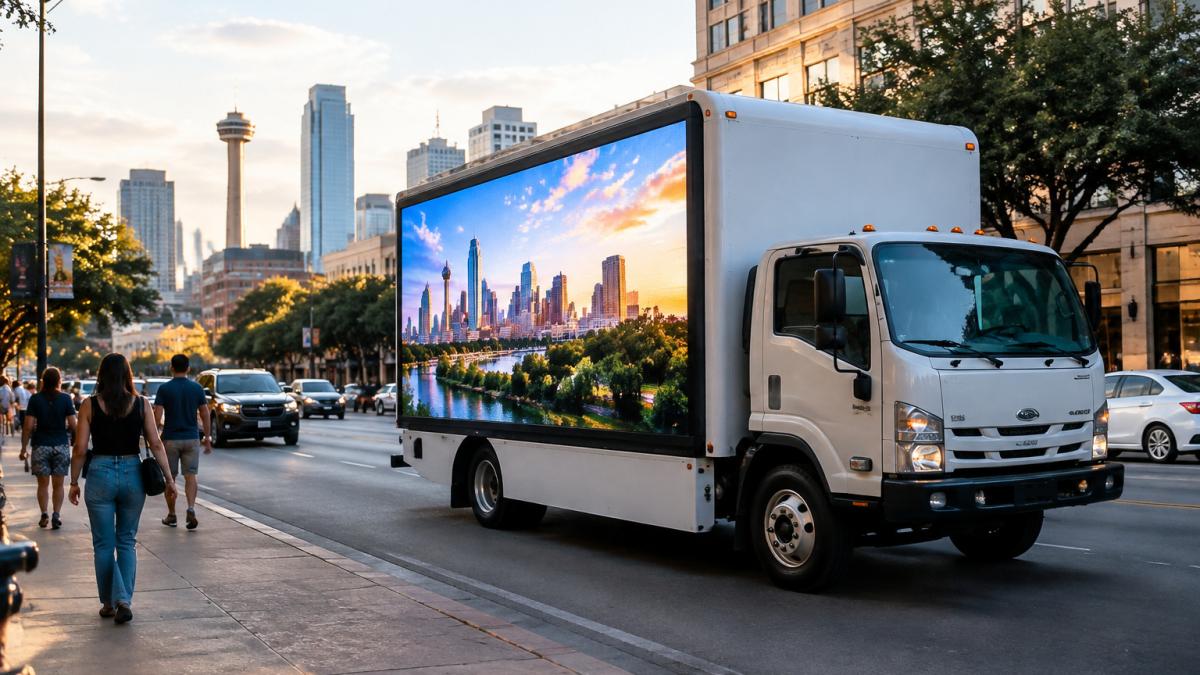
Texas Mobile Advertising offers a fleet that includes LED digital mobile billboard trucks, glass-walled display trucks and vinyl billboard trucks. Our LED units showcase video and image ads through onboard screens. Our glass-walled trucks can be transformed into mobile showrooms.
Choose digital when you need motion, changing messages or a stronger launch impact. Choose static vinyl when the message is simple and the budget is tighter. For pricing on any format, contact us for a quote based on your dates and routes.
Contact Us Now for a Free Consultation →
Alternatives to Premier Mobile Billboards: Side-by-Side Comparison
| Provider | Starting Price | Best For | Notes |
|---|---|---|---|
| Texas Mobile Advertising | Quote-based | Launches, events, multi-format campaigns | LED, glass-walled and vinyl trucks; 1,400+ completed campaigns |
| Premier Mobile Billboards | Contact for pricing | Digital mobile billboard campaigns | Pricing and specs not listed publicly |
| AdQuick | About $800/day (static vinyl, indicative) | Comparing formats and estimating costs | Rates are estimates, not quotes |
| American Guerrilla Marketing | Contact for pricing | Campaigns within broader marketing plans | Covers routing and multi-channel integration |
| Movia | Contact for pricing | Campaigns with measurement and digital integration | Emphasizes campaign measurement |
Here is how to narrow the field when comparing providers:
- Start with your format. Digital LED needs differ from static vinyl, so confirm each provider offers the format you need.
- Ask for the same quote terms. Request minimum booking, included services and routes from every provider.
- Confirm reporting. Ask how campaign performance will be measured before you sign.
- Check capacity. Multi-location launches need enough vehicles on the right dates.
Mobile Billboard Campaign Planning and Measuring Results
Start with a single clear objective, such as awareness in a new trade area, foot traffic to a store, or attendance at an event. Then choose routes, hours, and creative to match that goal. Map routes to the neighborhoods where your customers live, work, and shop, and confirm operating hours and any local restrictions before you lock dates.
Operational details decide whether a plan survives contact with reality. Before booking, confirm route permissions and any parking or staging restrictions in the areas you want to cover, the provider’s operating hours, and scheduling around events or peak traffic windows. A campaign that cannot legally park where your audience is will not deliver the reach you paid for.
Measurement is the part many buyers underestimate. Mobile billboards are harder to track than a call-in number on radio, and providers vary in what they can report. Ask for metrics in two categories: estimated reach and verified response.
- Estimated reach. Impressions, route completion, and dwell time are typically modeled from route logs, traffic patterns, and time-on-screen assumptions. They are useful for planning and for comparing proposals, but they are estimates, not audited counts.
- Verified response. Unique phone numbers, dedicated landing pages, promo codes, event or appointment sign-ups tracked by source, and before-and-after comparisons of store visits or inquiries in the campaign area give you harder evidence of impact.
A common pattern is to combine both: use estimated reach to judge coverage and route quality, and use verified response to judge whether the campaign moved behavior. Set your baseline before the campaign starts so you have something to compare against, and ask the provider for route logs and a reporting cadence in writing.
Watch out: Providers may present modeled impressions as if they were measured results, so ask explicitly which numbers are estimates and which are tied to a tracked response.
Finally, plan the campaign in phases. A short pilot on a focused route lets you test creative and timing before committing to a longer booking, and the pilot’s response data makes the case for or against scaling to additional routes or vehicles.
Choosing the Right Mobile Billboard Provider for Your Next Campaign
Choose a provider by matching its fleet, pricing transparency and reporting to your campaign goal. Ask each company to quote the same scope, including the format, dates, routes, minimum booking period and creative production. Then compare the totals, not the day rates.
Consider these questions when you evaluate providers:
- Does the company offer the format you need (digital, static or glass-walled)?
- Can it cover your target areas on your dates?
- Is pricing transparent, and what is included?
- How does it report results?
Texas Mobile Advertising has completed more than 1,400 mobile advertising vehicle campaigns and serves clients across Texas and surrounding states. If you are planning a launch, a store opening or an event, contact us for a free consultation and a quote based on your schedule and target areas.
Frequently Asked Questions
What are some good alternatives to billboards for advertising?
Common alternatives include transit advertising on buses and rail, street furniture displays, radio, digital out-of-home screens, and mobile billboard trucks. Each channel reaches audiences differently. Mobile billboards suit campaigns that need to reach specific neighborhoods, events, or store openings on short timelines, while static billboards suit long-term visibility along a fixed corridor. Compare cost per day, geographic reach, and whether your audience is on the move before choosing.
How much does a mobile billboard cost?
Pricing varies with the vehicle type, the number of days, the routes, and the level of creative production. Pricing depends on the vehicle type, the number of days, the routes, and the level of creative production. Digital LED trucks typically cost more. Request itemized quotes from several providers that show the daily rate, minimum booking period, driver and fuel costs, and creative setup so you can compare them directly.
What should I compare when choosing a mobile billboard company?
Start with the fleet: check whether the company offers LED digital trucks, glass-walled display vehicles, or vinyl trucks, and whether they fit your creative. Next, compare minimum booking periods, what is included in the price, and how routes are planned. Ask how the company tracks campaign performance and what reporting you will receive. Finally, ask for references or case studies from campaigns similar to yours, such as store openings or event promotion.
Are digital mobile billboards more effective than traditional billboards?
Digital mobile billboards can show video and rotating creative, which often helps capture attention in fast-moving traffic. Static billboards are less expensive per day and can work well for simple messages on a fixed route. Effectiveness depends on your objective, audience, and route. Ask providers for measurement methods, such as impressions estimates or traffic lift analysis, and decide based on the results you can verify rather than assumptions.
