
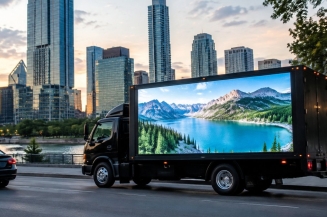
5 Reasons Mobile Billboards Outperform Static Signs
Last Updated: November 4, 2026
Quick Summary
Mobile billboards outperform static signs mainly because they move. A truck can drive planned routes past stores, venues and events, reaching a chosen audience instead of whoever happens to pass one fixed location. Motion-based LED content also tends to hold attention longer.
- Mobile units travel planned routes, while static signs stay fixed for the contract term.
- Routes can be timed to the hours when the target audience is most likely on the road.
- Plan at least three to five exposures per viewer in the target route over the campaign.
- Keep creative to one headline and one call to action that reads in under three seconds.
- Confirm local vehicle signage, parking and digital panel rules before booking each route.
Table of Contents
- What Mobile Billboards Are and How They Differ From Static Signs
- Precision Targeting and Audience Reach
- Engagement Rates, Brand Recall and Dwell Time
- Mobile Billboard Advertising Cost and Return on Investment
- Environmental Impact and Zoning Considerations
- Best Practices for Mobile Billboard Campaigns
- How to Measure Mobile Billboard Effectiveness
- Booking Your Mobile Billboard Campaign With Texas Mobile Advertising
- Frequently Asked Questions
What Mobile Billboards Are and How They Differ From Static Signs
A mobile billboard is an advertising panel mounted on a truck, trailer or other vehicle that drives planned routes through a market. A static sign stays in one fixed place for the length of its contract.
Texas Mobile Advertising builds this type of campaign with LED digital trucks, glass-walled display vehicles and vinyl billboard trucks.
Static signs have real strengths. They build long-term recognition in one location, and a well-placed board on a major corridor can run for months with little upkeep. The trade-off is that a static sign reaches whoever happens to pass it, and it cannot move toward a new audience.
Here is how the two formats compare on the factors that matter most to a campaign planner:
| Factor | Static sign | Mobile billboard |
|---|---|---|
| Location | Fixed for the contract term | Moves on planned routes |
| Audience | Whoever passes the site | Targeted by route, time and event |
| Content | Usually one static design | Video and image ads on LED screens |
| Launch flexibility | Limited to available sites | Can cover several areas at once |
| Best use | Long-term local presence | Short-term, high-visibility campaigns |
Precision Targeting and Audience Reach
Targeting is where mobile billboards pull ahead. For a worked example of how a fitness brand plans and runs a mobile billboard campaign in Texas, see that guide.

A new retail location, for example, can run a truck through the neighborhoods within a few miles of the store during the weeks before opening.
Route planning does have limits. The audience a truck reaches depends on traffic patterns, and a poorly chosen route wastes budget just as a poorly placed static sign does. Planners should review traffic data for each route before committing to it.
Engagement Rates, Brand Recall and Dwell Time
Engagement is harder to measure for any outdoor format, and mobile billboards are no exception. The sections below break down each factor with the mechanisms that actually move the numbers.
Why motion changes the attention equation
A static sign relies on a driver already looking in its direction. A mobile unit introduces the ad into a viewer’s field of view at a moment when the message is new, which is why motion content on LED screens tends to hold attention longer than a printed panel. Enclosed formats such as glass-walled display trucks can extend this further for experiential campaigns. The practical implication is that creative should be built for a moving viewer: one headline, one call to action, and a visual that reads in under three seconds. Dense text and multiple offers compete with the driving task and get tuned out.
Dwell time: what to expect and how to plan for it
Dwell time, meaning how long a person is exposed to an ad, is shorter for moving units than for a stopped audience at a venue or a signalized intersection. A common pattern is that a truck passing a pedestrian or a slow-moving corridor produces longer exposure than a highway pass. Planners should expect shorter dwell on high-speed routes and judge performance against campaign goals rather than an assumed exposure time. If the goal is recall, route the unit through slower traffic and event foot-traffic zones; if the goal is broad awareness, highway corridors still work but should be paired with repetition.
Repetition and recall
Brand recall is tied to repetition. A truck that returns to the same corridor across several weeks gives viewers more chances to remember the message, and frequency beats a single high-impact pass for most awareness goals. Read more on strategies to increase engagement using a mobile billboard. A practical rule is to plan at least three to five exposures per viewer in the target route over the campaign window, then measure recall with a short post-campaign survey in the target area. Watch out: running a single pass through a market and expecting measurable recall is the most common planning error in this format.
How to measure engagement without inventing numbers
Specific engagement figures for a given campaign depend on its routes, creative and market, so they should be tested rather than assumed. For a fuller walkthrough of the tracking methods, see how to measure results in an out-of-home campaign. Useful proxies include unique promo codes and dedicated landing page URLs printed on the creative, QR codes that route to a campaign-specific page, and call tracking numbers. Pair those direct measures with foot-traffic data from the target area and web analytics filtered by geography. Most practitioners find that a control area, a comparable neighborhood that does not receive the campaign, makes the before-and-after comparison far more credible than campaign numbers alone.
The digital retargeting multiplier
A high-value mechanism most static-sign campaigns cannot replicate is geofencing. When a mobile billboard runs a planned route, the campaign can define a virtual boundary around that route and serve mobile display or social ads to devices that enter the zone during the campaign window. This turns a passing exposure into a second, measurable touchpoint on the viewer’s phone. The practical setup requires a media partner that can ingest route data and apply geofence targeting, plus a clear privacy compliance review before launch.
Mobile Billboard Advertising Cost and Return on Investment
Campaign cost depends on several factors: the number of vehicles, the length of the campaign, the routes covered, the creative production and the number of markets served. To weigh short-term against long-term runs, see how to determine the length of your mobile billboard campaign.
Contact Us Now for a Free Consultation →
To judge return on investment, compare the campaign cost against the outcomes it is meant to produce. Useful measures include store visits, website traffic in the target area, redemption of an offer, call volume and event attendance.
Radio and television comparisons often look at cost per listener or viewer. For a mobile campaign, a fairer comparison uses cost per local exposure within the target route, combined with the business outcomes above.
Environmental Impact and Zoning Considerations
Mobile billboards and static signs each carry an environmental footprint, and the comparison depends on how each is measured. A static sign has a fixed footprint: materials, installation, lighting and maintenance at one site. A mobile unit adds vehicle fuel use and emissions from the miles it drives, but it can cover several areas without new permanent structures. Planners should consider the total miles a route requires, since empty driving adds emissions without adding exposure.
A compliance checklist before you book routes
Most articles on this topic skip the legal hurdles, which is where campaigns actually fail. Use this checklist with each jurisdiction before booking:
- Vehicle signage rules. Confirm whether the jurisdiction regulates advertising panels on vehicles differently from standard vehicle wraps, and whether the panel size or illumination triggers a permit.
- Parking and stopping limits. Many cities and counties restrict where a vehicle may park or display advertising, how long a unit may stop, and whether stopping in a commercial zone or near a school is allowed.
- Digital and lighted panel rules. Some zones prohibit lighted or digital panels, or restrict brightness after dark. Confirm before committing to an LED truck for a given route.
- Event and venue permissions. Festivals and private venues often require separate approval for a display vehicle on or near the grounds.
- State and local sign codes. Municipal sign codes written for fixed structures sometimes sweep in mobile units; read the definition section, not just the enforcement section.
- Insurance and vehicle registration. Confirm the operator carries the commercial auto and general liability coverage the venue or municipality requires.
Watch out: a campaign that is legal in one city may need changes in the next, so confirm requirements with each local government before booking routes rather than assuming a single approval covers a multi-city run.
Creative best practices for a moving ad
Design principles for high-speed readability are rarely addressed in competing guides, and they matter more for mobile than for static. Keep the word count low, a headline and a call to action is usually enough. Use high contrast between text and background, and size type so it reads at highway distance, not just at a stoplight. Avoid fine print and QR codes that require a long stare; if a QR code is used, make it large and place it where a pedestrian or slow-traffic viewer can scan it. Short video loops work on LED screens, but the first frame should carry the core message because many viewers will see only that frame.
Best Practices for Mobile Billboard Campaigns
Several habits tend to support clearer campaign results.
- Set one clear goal. Choose a single outcome, such as store visits or event sign-ups, before selecting routes.
- Match routes to the audience. Pick corridors and times that reach the people most likely to act.
- Keep the message simple. Drivers have a few seconds to read a panel, so one headline and one call to action work better than a list of offers.
- Plan repetition. Returning to the same routes over several weeks builds recall more reliably than a single pass.
- Build the creative for the format. Short video loops and large type suit LED screens. Dense text does not.
How to Measure Mobile Billboard Effectiveness
Measurement starts before the campaign launches. Record the baseline numbers you expect to change: store traffic, web visits from the target area, call volume and offer redemptions. Then track the same numbers during and after the campaign.
Use a control where possible. If one area receives the campaign and a comparable area does not, the difference between them shows more than a before-and-after comparison alone.
Expect some results to be indirect. Drivers who see a truck may search for the brand later or visit the store on a different day. Combine the direct measures with trend data over several weeks rather than judging a campaign on a single day’s numbers.
Booking Your Mobile Billboard Campaign With Texas Mobile Advertising
A campaign is easiest to plan when the goal, budget and target areas are clear from the start. Texas Mobile Advertising works with marketing managers, event coordinators and agencies on mobile advertising campaigns.
To get started, contact Texas Mobile Advertising for a free consultation.
Frequently Asked Questions
What are the primary advantages of mobile billboards over static signs?
Mobile billboards move to where your audience is, including high-traffic corridors, event crowds and specific neighborhoods, instead of relying on a fixed location. They also deliver video and image content through onboard LED screens, which static vinyl boards cannot do. Static signs remain useful for constant, long-term presence at one location, so the right choice depends on your campaign goal.
Are mobile billboards more cost-effective than traditional static billboards?
Cost-effectiveness depends on the campaign, not on a single price comparison. Mobile billboard pricing depends on fleet size, campaign length, route complexity and production needs, so there is no universal figure to quote. Compare the cost per impression and the number of targeted audience contacts you can buy with each option, rather than the headline rental rate. For current pricing tailored to your markets and dates, contact Texas Mobile Advertising for a quote.
How does audience reach differ between mobile and static billboard advertising?
A static billboard reaches the traffic that passes its fixed location, so its audience is limited to that corridor. A mobile billboard can be routed through several neighborhoods, past event venues or near store openings, which lets you target areas your static inventory does not cover. Routing choices and driving patterns shape exactly who sees the ad, so plan routes around the audience you want to reach. Ask your provider how they plan routes before you commit to a campaign.
Can mobile billboards be targeted to specific demographics or locations?
Yes. Mobile billboards can be routed to specific neighborhoods, retail trade areas, healthcare corridors or events where your target audience gathers. Some providers also use demographic data to shape route planning. Targeting works best when the route, timing and creative match the audience you are trying to reach, so define your audience and the locations they frequent before you set a route.
