
High-Impact Advertising for Local Events: A Strategic Guide
Table of Contents
- Why High-Impact Advertising for Local Events Matters
- Local Event Promotion Ideas That Drive Real Attendance
- Mobile Billboard Advertising for Events: Visibility That Works
- Event Promotion Timeline: When to Launch Each Channel
- How to Measure Event Marketing Success
- Budget Allocation and Cost Efficiency for Local Campaigns
- Frequently Asked Questions
Last Updated: October 19, 2026
Why High-Impact Advertising for Local Events Matters
High-impact advertising for local events cuts through the noise. Traditional ads get ignored or tuned out, but when you put your message on wheels, people notice, they can’t scroll past a mobile billboard truck or turn off an LED display rolling down their street.
Local events live or die on attendance, and high impact advertising for local events is what determines whether you get it. The problem isn’t finding an audience, it’s reaching the right audience at the right moment, when they’re actually thinking about attending.
This is where high-impact advertising for local events becomes essential. You’re not broadcasting to millions, you’re targeting specific neighborhoods, times, and people, putting your event in front of decision-makers who can actually show up.
At Texas Mobile Advertising, we’ve worked with event organizers, retailers launching new locations, and healthcare systems building local awareness.
The difference between a packed event and an empty one often comes down to one thing: whether your target audience even knew it was happening. High-impact advertising for local events solves that problem by putting your message directly in front of people in your geographic area.
Local Event Promotion Ideas That Drive Real Attendance
Event promotion works best when you layer multiple channels. Social media alone won’t fill seats. Email alone won’t drive foot traffic. But social media plus paid advertising plus mobile visibility plus community partnerships creates momentum that’s hard to ignore.
Geographic Targeting and Audience Research
Start by knowing exactly who you’re trying to reach, not “people interested in music” but families with kids under 12, professionals aged 25-40, or people within a 5-mile radius of your venue.
Geographic targeting means your ads only show to people in specific locations, so you focus budget on neighborhoods where your audience actually lives and works.
Audience research answers three questions:
- Where do they spend time online?
- What times are they most active?
- What messages resonate with them?
Research doesn’t require expensive tools. Look at past attendees’ locations, see what they follow on social media, and ask directly: “How did you hear about this event?”
Social Media and Paid Advertising Strategy
Social media is where people discover events. Facebook and Instagram let you target by location, age, interests, and behavior. That specificity is your advantage.
Build your paid social strategy in three phases:
-
Awareness phase (8-10 weeks before): Show your event exists. Use video, images of past events, testimonials from previous attendees. Keep the message simple: “This event is happening. Here’s what it’s about.”
-
Consideration phase (4-6 weeks before): Answer questions. Why should people come? What’s unique about your event? Who else is attending? Use carousel ads showing multiple reasons to attend.
-
Action phase (2-4 weeks before): Create urgency. “Limited spots remaining.” “Early bird pricing ends Friday.” “Register now.” Make the call to action crystal clear.
Paid social works because it reaches people actively using those platforms: a Facebook ad reaches someone scrolling at lunch, who sees your event, clicks, and registers right there, no friction.
Test different ad creative with small budgets first. One image or video might drive twice as many registrations as another. Find what works, then scale your spending toward those winning ads.
Community Partnerships and Influencer Outreach
Local influencers and community partners amplify your reach, an influencer with 10,000 local followers reaches people you couldn’t afford to reach through paid ads alone.
Community partnerships work differently: a restaurant partnering with a local fitness studio for a wellness event reaches both audiences, and a clinic partnering with a community center reaches people already interested in health.
The best partnerships feel natural, not forced. A music festival should partner with local venues, record stores, and musicians; a restaurant opening with food bloggers and local news outlets. Match your partners to your audience.
Mobile Billboard Advertising for Events: Visibility That Works
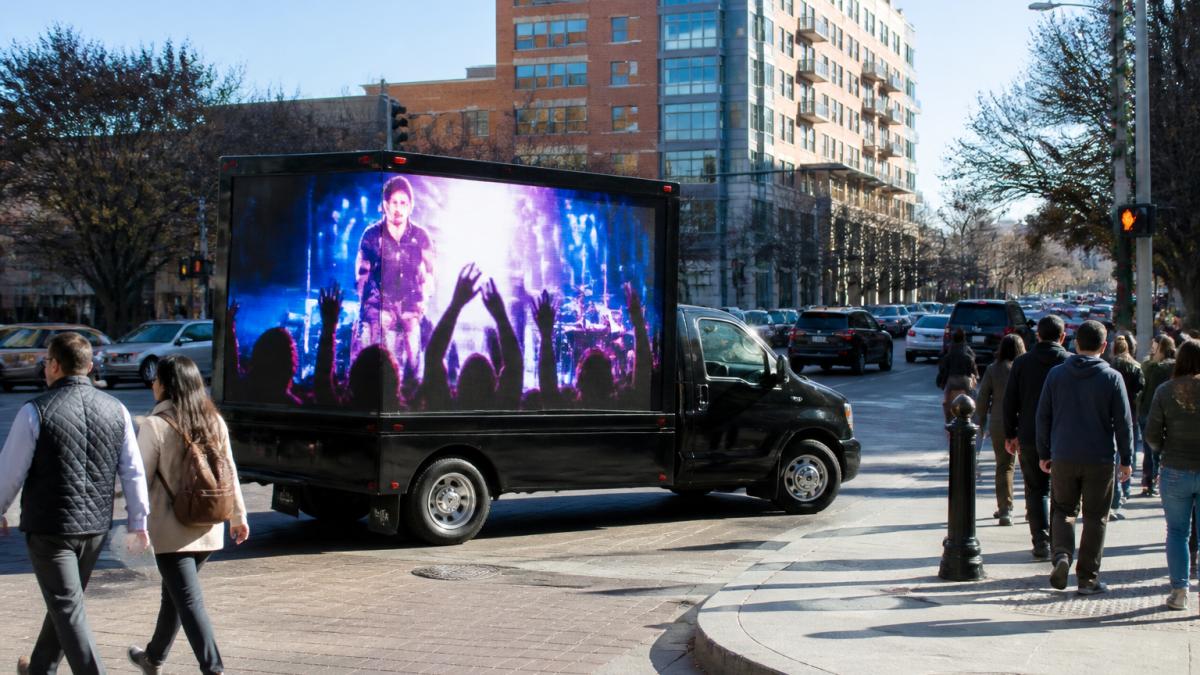
Mobile billboard advertising for events puts your message in motion. Unlike a static billboard people pass once, a mobile billboard circulates through neighborhoods multiple times, on the commute, at lunch, on the way home, and repetition builds awareness.
LED Digital Trucks and Glass-Walled Displays
LED digital trucks are the most flexible option: you can change the message instantly, Monday’s ad promotes your music festival, Tuesday’s a restaurant opening, with no printing costs.
Glass-walled display vehicles work differently, they’re mobile showrooms. A healthcare system can outfit one with service information, a retail chain can display products, a restaurant can show menu items.
Both approaches grab attention in ways traditional advertising can’t. A static billboard competes with hundreds of others; a moving LED truck or glass-walled vehicle is novel.
Research shows people are more likely to remember ads they see multiple times in different contexts (Taking repeated exposure into account).
Strategic Placement and Route Planning
Placement determines effectiveness. A mobile billboard driving through neighborhoods where your target audience lives works; one driving through random areas wastes fuel and budget.
Strategic route planning means:
Contact Us Now for a Free Consultation →
- Identifying high-traffic areas where your audience spends time
- Scheduling routes during peak hours (morning commute, lunch, evening commute)
- Rotating routes to maximize geographic coverage
- Concentrating placement near your event venue in the final weeks before the event
For a restaurant opening, route the truck past nearby offices, residential neighborhoods, and shopping areas. For a healthcare clinic, route it past gyms, wellness centers, and residential areas with older populations.
Texas Mobile Advertising specializes in this strategic placement. We analyze your target audience, identify where they spend time, and create routes that maximize visibility, driving in front of the right people at the right time.
Avoid placing mobile billboards in areas where your target audience doesn’t live or work. A truck driving through industrial zones when your event targets families won’t drive registrations. Geographic precision matters more than total miles driven.
Event Promotion Timeline: When to Launch Each Channel
Timing determines success. Launch too early and people forget. Launch too late and there’s no time for awareness to build. Launch all at once and you waste budget before the event date.
12 Weeks Before: Foundation and Planning
Twelve weeks out, lay groundwork. Finalize your event details, confirm venue, date, speakers, and entertainment, build your event website or landing page, set up registration, and create your email list. You’re not advertising heavily yet, you’re building the infrastructure that will convert interested people into attendees.
Start audience research. Who attended your last event? Who are your competitors attracting? What messaging resonates in your market? Use this research to inform everything that comes next.
8-4 Weeks Before: Campaign Activation
Eight weeks out, launch your awareness campaign with high impact advertising for local events: mobile billboards start circulating, paid social ads run daily, and email goes out weekly. Social media ads start running, email campaigns begin, and influencer and community partnerships activate.
Four weeks out, intensity increases. You’re not launching new channels. You’re doubling down on what’s working. If social media ads are driving registrations, increase budget. If mobile billboards are generating buzz, extend routes. If email is converting well, send more frequently.
4 Weeks to Event Day: Intensity and Urgency
Mobile billboards shift strategy. Instead of circulating broadly, they concentrate near your venue. Instead of promoting the event generally, they emphasize the date and location. “This Saturday. 6 p.m. Downtown Arena. Register now.”
Email frequency increases to 2-3 times per week, with subject lines emphasizing urgency: “Last chance to register.” “Only 48 hours left.” The final week is all-hands, social ads run constantly, mobile billboards circle your venue, and email goes daily, getting every interested person across the finish line.
How to Measure Event Marketing Success
Advertising without measurement is guessing, you don’t know what worked, what to repeat, or where to spend next time.
Key Performance Indicators and Attribution
Track these metrics:
- Registrations: How many people registered? Which channel drove them?
- Attendance: How many registered people actually showed up?
- Cost per registration: Total ad spend divided by registrations. If you spent $5,000 and got 500 registrations, that’s $10 per registration.
- Cost per attendee: Total ad spend divided by people who actually attended. This is your real metric.
- Channel attribution: Which channels drove the most registrations? Social media? Email? Mobile billboards? Partnerships?
Attribution is tricky. Someone sees your mobile billboard on Monday, clicks your social ad on Wednesday, receives an email on Friday, and registers Saturday, all of them worked together. Use UTM parameters in your links and a unique code per channel so you know which one brought each registration.
Tracking Local Foot Traffic and Registrations
For events that rely on walk-up attendance, tracking foot traffic matters. Use these methods:
- Event check-in: Count people as they arrive. Simple but effective.
- Surveys: Ask attendees, “How did you hear about this event?” Their answers show which channels worked.
- Unique discount codes: Give different codes to different channels. “Use code FACEBOOK for 10% off.” Track which codes get used.
- Traffic counters: Devices that count people passing a location. Place them near your venue to measure foot traffic spikes on event day.
For healthcare clinics, restaurant openings, and retail launches, foot traffic is the real measure of success. Registrations matter, but people walking through your doors matter more.
The channel that drove the most registrations might not be the channel that drove the most valuable registrations. Track not just volume but quality: Which channels brought people who actually attended? Which brought people who spent money or signed up for services?
Budget Allocation and Cost Efficiency for Local Campaigns
Budget allocation depends on your goals, your audience, and what channels work best in your market.
A common approach:
- 40% to paid social advertising (Facebook, Instagram)
- 25% to mobile billboard advertising
- 20% to email marketing and partnerships
- 15% to content creation and testing
This isn’t a rule. It’s a starting point. If your audience is older and less active on social media, shift budget toward email and mobile billboards.
Test before scaling.
Measuring and optimizing local event advertising is an ongoing process.
Texas Mobile Advertising helps event organizers, retailers, healthcare systems, and restaurant groups execute this strategy. We specialize in mobile billboard placement that drives foot traffic and registrations.
Contact us for a free consultation. Let’s discuss your event and how mobile billboard advertising can drive attendance.
Frequently Asked Questions
How far in advance should you advertise a local event?
Start high-impact advertising for local events 12 weeks before your event date. This timeline allows 12 weeks for foundational planning and audience research, 8-4 weeks for campaign activation across paid social and partnerships, and 4 weeks to event day for intensity and urgency. Shorter timelines work for established audiences, but new or unfamiliar events need the full runway to build awareness, generate registrations, and achieve attendance goals.
How do mobile billboards help promote local events?
Mobile billboard advertising for events captures attention through movement and scale. Unlike static billboards, LED digital trucks and glass-walled display vehicles travel directly to your target geographic areas, showing video and image content to both vehicle and pedestrian traffic. This hyperlocal approach reaches people in real time, builds event awareness in high-foot-traffic zones, and drives last-minute registrations. The combination of visual impact and strategic route planning ensures your message reaches your audience where they live, work, and gather.
What’s the best way to measure whether event advertising is working?
Track how to measure event marketing through multiple channels: use unique promo codes or QR codes on each ad platform to attribute registrations directly, monitor cost per registration across paid social, email, and mobile campaigns, measure foot traffic to event venues using location data or manual counts, and survey attendees about which advertising channel they saw first. Compare impressions, click-through rates, and conversion rates against your initial KPIs. This multi-touch attribution shows which channels drive the highest-quality registrations and inform future budget allocation.
Can mobile billboard advertising work for healthcare or service-based events?
Yes. Healthcare systems, clinics, and service providers use mobile billboard advertising for community health events, clinic open houses, and awareness campaigns. The key is targeting geographic areas near your locations and timing campaigns around key health observances or seasonal needs. Local event promotion ideas for healthcare include partnering with community organizations, running campaigns 8-12 weeks before events, and measuring success through event attendance and follow-up appointment bookings rather than immediate sales.